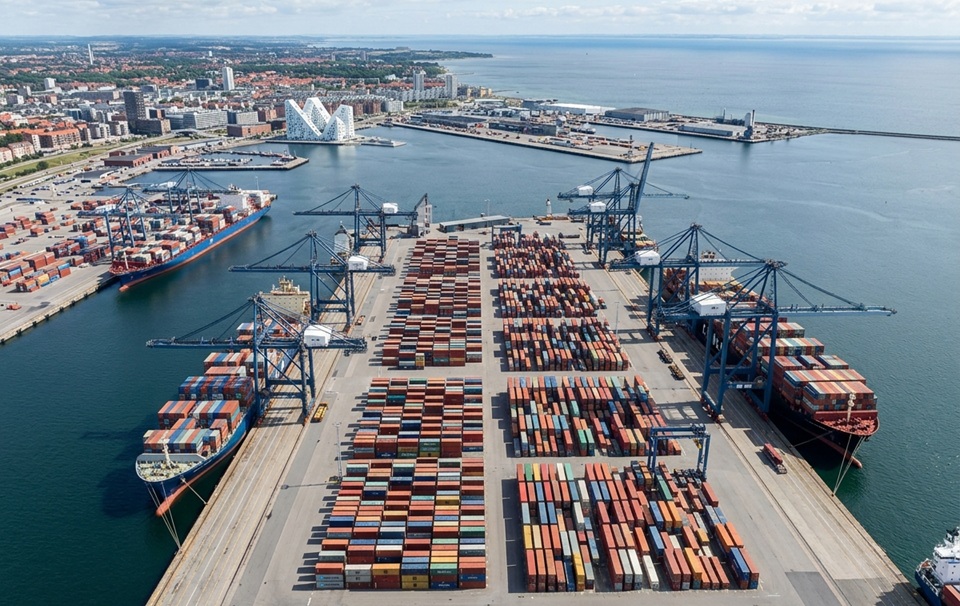
1. Why Aarhus Is Redefining the Nordic Logistics Landscape
For importers in China looking to access the affluent Nordic market, the choice of entry port is one of the most consequential logistics decisions you can make. For decades, many businesses defaulted to larger continental European hubs like Hamburg, Rotterdam or Antwerp, then trucked goods north into Scandinavia. But that model is rapidly changing. Increasing congestion at major North Sea ports, rising inland trucking costs, tighter environmental regulations and growing demand for faster delivery are pushing importers to rethink their Nordic entry strategies. At the centre of this shift stands Aarhus Port, Denmark’s largest container hub, which has emerged as the most efficient, cost-effective and strategically positioned gateway for goods entering the Nordic and Baltic regions from Asia.
The numbers speak for themselves. Aarhus now handles over 70% of all container traffic in Denmark, consolidating its position as the country’s undisputed leading commercial port. Year after year it gains market share from competing ports, including Copenhagen, as carriers and shippers recognise its operational advantages. For Chinese exporters and Danish importers alike, Aarhus has become the default port of call for containerised cargo moving between the Far East and Scandinavia. But the port’s significance extends far beyond Denmark itself. Its unrivalled intermodal connections turn it into a true pan-Nordic distribution hub, serving not just Denmark but also Norway, Sweden and the wider Baltic Sea region.
This guide explains in detail why Aarhus Port has become the preferred Nordic gateway for Chinese imports. We break down its deep-water terminal capabilities, its industry-leading rail network, its global shipping connectivity, its operational efficiency advantages, and the tangible benefits it delivers to importers. Whether you ship full container loads (FCL) of industrial goods or less-than-container loads (LCL) of consumer products, understanding Aarhus’ advantages will help you reduce costs, speed up delivery and improve the reliability of your entire Nordic supply chain.
Supertrans Logistics specialises in China-to-Denmark freight solutions, with deep expertise in Aarhus Port operations and intermodal distribution across the Nordic region. We work with hundreds of Chinese manufacturers and Danish importers, helping them leverage Aarhus’ strategic advantages to build more efficient supply chains. This guide draws on our years of hands-on experience operating through this port to deliver a practical, business-focused analysis of what makes Aarhus the smart entry point for the Nordic market.
2. Denmark’s Strategic Position as the Northern European Trade Hub
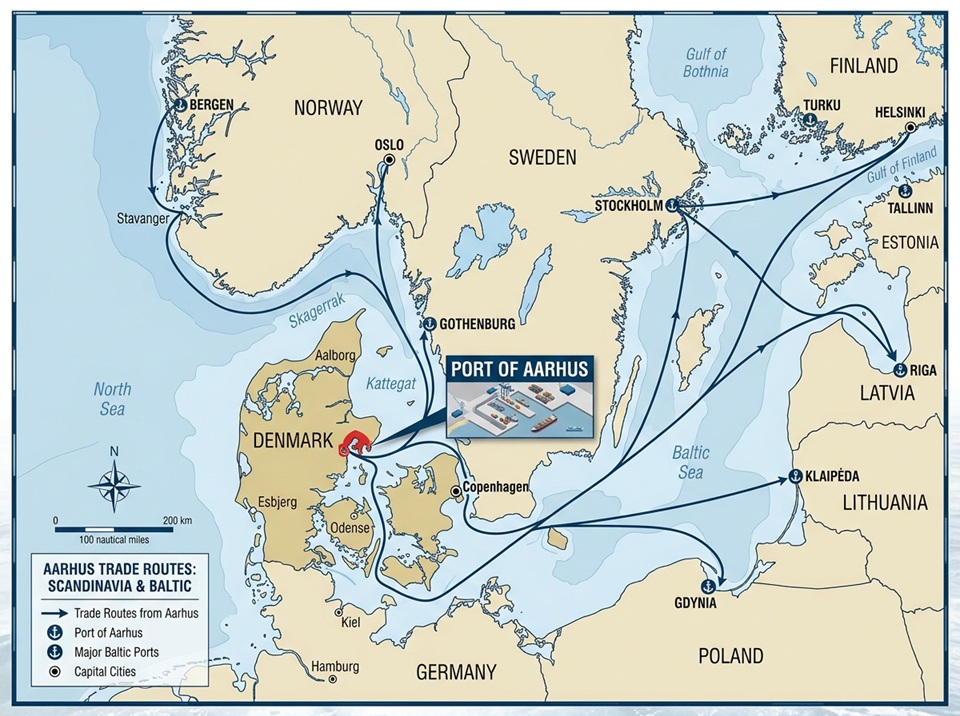
Denmark’s unique geography is what makes Aarhus such a powerful logistics hub. Situated at the narrowest point of the Kattegat, at the entrance to the Baltic Sea, Denmark controls the main maritime access route to all Baltic Sea economies. It also sits directly on the shortest deep-sea shipping lane between the Far East and the Nordic countries. For vessels sailing from Shanghai via the Suez Canal and into the North Sea, Aarhus is the first major Nordic deep-water port of call. This geographical advantage translates directly into faster transit times and lower shipping costs compared to routing cargo via more southerly European ports.
The Nordic Market Opportunity
The Nordic region (Denmark, Sweden, Norway, Finland and Iceland) represents one of the wealthiest consumer and industrial markets in the world. With a combined population of around 27 million, high disposable incomes, strong industrial sectors and sophisticated e-commerce markets, it is a highly attractive destination for Chinese exports. But the region’s geography – spread across multiple countries, peninsulas and islands – makes distribution complex and expensive.
Historically, many importers served the Nordic market from central European hubs. Goods from China would discharge at Hamburg or Rotterdam, then be trucked or trained north. But this model is increasingly problematic. Rising road tolls, driver shortages, congestion and environmental restrictions on heavy trucks are pushing inland transport costs steadily higher. The longer the road leg, the more these costs eat into product margins. Routing via Aarhus instead dramatically shortens the overland distance to final Nordic destinations, reducing both cost and transit time.
Aarhus vs. Competing Nordic Ports
Denmark has several commercial ports, but Aarhus stands head and shoulders above the rest as a container hub. Copenhagen, the capital port, handles smaller volumes and is more focused on passenger traffic, roll-on/roll-off freight and local distribution. Its container capacity is limited and it cannot accommodate the largest deep-sea vessels. Esbjerg on the west coast specialises in offshore energy and bulk cargo. Fredericia is growing as a secondary rail hub but remains much smaller than Aarhus.
Outside Denmark, Gothenburg in Sweden and Oslo in Norway are the main competing container ports. But both sit further north, adding several sailing days to the voyage from China. They also have less frequent deep-sea services and higher handling costs. For most Chinese cargo bound for the wider Nordic region, Aarhus offers the optimal balance of sailing distance, port efficiency, intermodal connections and distribution reach.
Key Geographic Advantage
Aarhus sits on the shortest shipping route between China and the Nordic countries. It is also the only major Danish port capable of handling the largest post-Panamax container vessels. This combination makes it the natural first port of call for Asia-Nordic services.
As supply chains continue to regionalise and companies look for shorter, more resilient distribution networks, Denmark’s position as the natural gateway to the north of Europe becomes ever more valuable. For Chinese importers, establishing a Nordic distribution strategy built around Aarhus Port delivers both immediate cost savings and long-term strategic advantage.
3. Deep-Sea Terminal Advantage: Built for Modern Mega-Vessels
The single most important infrastructure advantage of Aarhus Port is its world-class deep-sea container terminal, operated by APM Terminals. Purpose-built for the modern era of large-scale container shipping, this terminal sets Aarhus apart from most other Nordic ports and enables it to compete with the largest hubs in Northern Europe.
Accommodating the Largest Container Ships
With 14 metres of water depth alongside its main container berths, Aarhus can comfortably accommodate the largest post-Panamax and super-post-Panamax container vessels afloat, up to and beyond 20,000 TEU capacity. This is critically important because the main deep-sea services between Asia and Europe now deploy these very large vessels. Only ports that can handle these mega-ships can be included on direct rotation schedules. Ports that cannot are relegated to feeder status, relying on smaller feeder vessels to transfer containers from larger hub ports – adding cost, time and handling.
Aarhus is the only port in Denmark capable of handling these ultra-large container vessels. This means it is the only Danish port that appears on the main rotation schedules of the major global carriers like Maersk, MSC, Hapag-Lloyd and CMA CGM. For Chinese importers, this means direct sailings from Shanghai and other major Chinese ports straight to Aarhus, with no transhipment required at intermediate European hubs. Direct services mean faster transit, lower risk of damage or loss, fewer handling steps and more reliable scheduling.
Modern, Efficient Terminal Operations
The APM Terminals Aarhus facility is one of the most modern and efficient container terminals in Northern Europe. It features eight ship-to-shore gantry cranes including super-post-Panamax units, automated stacking systems, and on-dock rail infrastructure. The terminal achieves among the highest crane productivity rates in the region, moving up to 35 container lifts per crane per hour. This efficiency translates directly into shorter port stays for vessels, faster turnaround times and lower terminal handling charges for shippers.
The terminal also features 750,000 square metres of storage area, plus dedicated facilities for special cargo types including hazardous goods, out-of-gauge cargo and temperature-controlled units. This versatility means Aarhus can handle virtually any type of containerised cargo from China, from standard dry goods to heavy machinery, chemicals and refrigerated products.
Capacity for Growth
Aarhus Port is not standing still. Major expansion plans are underway to increase capacity still further, including 84 hectares of new port area and a new dry port logistics centre at Harlev, west of Aarhus. This ongoing investment ensures that the port will be able to handle growing trade volumes with China for decades to come, without the congestion and capacity constraints that are plaguing many other European ports.
Why This Matters for Chinese Shippers
Many smaller European ports cannot accept the large vessels used on main Asia-Europe routes. Cargo has to be transhipped via hubs like Hamburg or Rotterdam, adding 3-7 days and extra costs. Aarhus’ deep-water capability gives you direct vessel calls from Shanghai, cutting out the middleman.
4. On-Dock Rail Network: Faster Hinterland Distribution Across Scandinavia
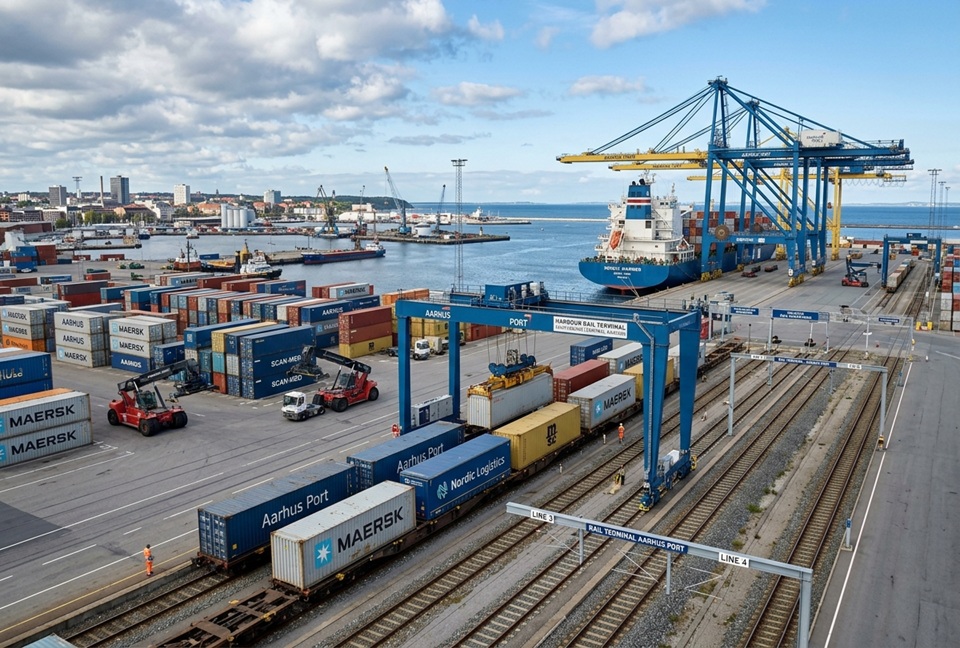
Excellent maritime infrastructure is only half the story. A port’s true value as a gateway lies in how efficiently it can move cargo onwards from the quay to final inland destinations. This is where Aarhus truly distinguishes itself from competing ports. Its integrated on-dock rail network provides fast, efficient and environmentally friendly hinterland connectivity that is unmatched in the Nordic region.
Dedicated On-Dock Rail Terminal
Unlike many ports where rail terminals are located several kilometres away from the container yard, Aarhus has three 400-metre rail tracks directly on the dock face. This means containers can be transferred directly from ship to rail without intermediate road haulage. This seamless intermodal transfer saves time, reduces cost and minimises handling risk.
APM Terminals operates a dedicated fast rail service connecting Aarhus directly with the Taulov / Fredericia container terminal in central Denmark. The service covers the distance in just 3 hours, with 4-6 departures every week. From Taulov, further rail connections extend to Copenhagen’s Høje Tåstrup terminal and onwards to Aalborg in the north of Jutland. This creates a high-capacity rail spine running the length of Denmark, all fed directly from Aarhus port.
Wider Scandinavian & Baltic Rail Reach
Beyond Denmark, the rail network connects Aarhus to the wider Scandinavian and Baltic markets. From the Danish rail hub at Fredericia, services cross the border into Sweden, connecting to Gothenburg, Malmö and Stockholm. Feeder rail and barge services also extend eastwards into the Baltic Sea region, reaching countries like Poland, Lithuania, Latvia and Estonia.
This rail connectivity turns Aarhus from a Danish port into a true regional distribution hub. Instead of shipping separate containers to each Nordic country, importers can consolidate volume through Aarhus and use rail to distribute onwards. This consolidation delivers significant economies of scale and reduces overall logistics costs substantially.
Environmental & Cost Advantages of Rail
Shifting hinterland distribution from road to rail delivers both financial and environmental benefits:
- Lower cost: Rail transport is significantly cheaper per tonne-kilometre than road transport for long-distance inland hauls.
- Lower emissions: Rail produces approximately 8 times less CO₂ per tonne of freight than road transport. The Aarhus-Taulov line is currently being electrified, which will reduce emissions even further from 2026 onwards.
- Less congestion: Rail services are not affected by motorway congestion, road works or peak hour delays, delivering more reliable transit times.
- Regulatory compliance: Using rail helps businesses meet increasingly stringent EU and national emissions reduction targets and avoid road tolls and low-emission zone charges.
Road Connectivity
In addition to rail, Aarhus also benefits from excellent road connections. The European E45 motorway runs directly to the port, providing fast road access to the entire Jutland peninsula and onwards to Germany and continental Europe. For local distribution and last-mile delivery within Denmark, the road network is modern, efficient and well maintained. This combination of on-dock rail and direct motorway access gives importers maximum flexibility to choose the best mode for each shipment.
Key Distribution Benefit
For Chinese importers serving the whole Nordic market, routing all cargo through Aarhus and using rail for onward distribution is typically 15-25% cheaper than shipping separate containers to individual national ports. It also simplifies inventory management with a single point of entry.
5. Global Route Network: Direct Far East Links & Baltic Feeder Connectivity
Aarhus Port boasts one of the strongest shipping route networks of any Nordic port, with direct deep-sea connections to all major global trade zones and an extensive feeder network covering the entire Baltic Sea region. For Chinese importers, the depth and frequency of Asia services is the most critical factor.
Direct Deep-Sea Services to China
Aarhus is served by all the major global container lines, including Maersk, MSC, Hapag-Lloyd and CMA CGM. Critically, it is included on the main rotation of several direct Asia-Europe services. This means there are regular direct sailings between Shanghai, Ningbo, Shenzhen and other major Chinese ports and Aarhus, with no need for transhipment at intermediate European hubs.
Recent network developments have strengthened these links further. The Maersk-Hapag-Lloyd Gemini partnership introduced new direct routes connecting Aarhus with the world’s largest ports, including Shanghai – the world’s busiest container port. These direct services provide Chinese importers with reliable, fixed-day weekly sailings and consistent transit times.
| China Port | Transit Time to Aarhus (port-to-port) | Sailing Frequency |
|---|---|---|
| Shanghai | 28 – 35 days | Weekly direct services |
| Ningbo / Zhoushan | 28 – 36 days | Weekly direct services |
| Shenzhen (Yantian / Shekou) | 29 – 37 days | Weekly direct services |
| Qingdao | 29 – 37 days | Bi-weekly services |
| Guangzhou | 30 – 38 days | Bi-weekly services |
*Indicative transit times for direct FCL services. LCL services may add 3-7 days for consolidation and deconsolidation.
Baltic Sea Feeder Network
Beyond deep-sea services, Aarhus functions as a major feeder hub for the entire Baltic Sea region. Regular short-sea feeder services connect Aarhus with ports in Sweden, Finland, Estonia, Latvia, Lithuania, Poland and Germany. This means that cargo discharged from deep-sea vessels from China can be efficiently transhipped onto smaller feeder vessels for delivery to smaller Baltic ports that cannot accommodate large deep-sea ships.
This feeder network is what elevates Aarhus from a national port to a truly regional gateway. For Chinese exporters looking to serve multiple markets around the Baltic, shipping in bulk to Aarhus then feeding onwards to individual destination ports is significantly more cost-effective than trying to serve each port with direct deep-sea shipments.
European & Global Connectivity
Beyond Asia and the Baltic, Aarhus also offers regular services to North America, the Mediterranean, the Middle East and other global regions. For Danish exporters sending goods back to China, the same direct services provide reliable export capacity. This balance of import and export trade helps keep rates competitive and service frequencies high.
Network Advantage Summary
Direct China services + comprehensive Baltic feeder network + intermodal rail hinterland = Aarhus is the only port in the region that can efficiently serve the entire Nordic and Baltic market from a single entry point.
6. Operational Efficiency: Speed, Reliability & Cost Performance
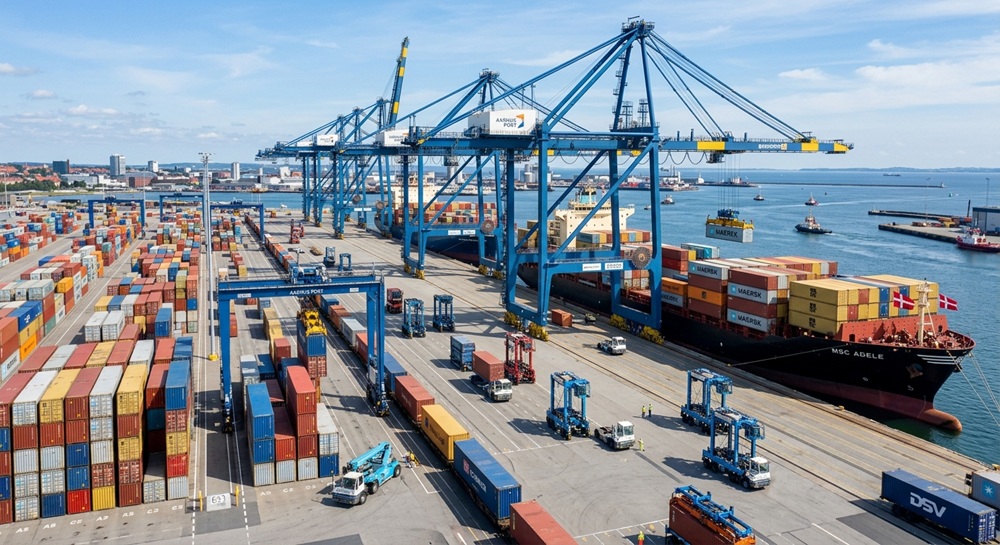
Infrastructure and connectivity are important, but what ultimately matters for importers is how well the port actually performs day to day. On measures of speed, reliability, cost efficiency and customs clearance, Aarhus consistently ranks among the best performing ports in Europe.
Fast Turnaround & Short Dwell Times
Aarhus is renowned for its operational efficiency. The modern terminal equipment, experienced workforce and optimised processes mean vessels spend less time in port. Average vessel turnaround times are among the shortest in Northern Europe. For importers, this means your cargo spends less time sitting at the dock and more time moving towards its destination.
Container dwell times – the time containers spend in the terminal after discharge before being picked up – are also very competitive. Efficient gate operations and pre-clearing processes mean containers can be released within hours of vessel arrival. This is a stark contrast to some larger European hubs where containers can sit in the terminal for days due to congestion and delays.
Customs Clearance Efficiency
Danish customs operates a highly digitalised, risk-based clearance system at Aarhus Port. For compliant importers with good records, most declarations are processed automatically with no physical inspection. Pre-lodgement of declarations before vessel arrival allows clearance to be completed while the ship is still at sea, so containers are ready for immediate release upon docking.
For specific industry sectors like industrial machinery, steel products and technical equipment, Aarhus customs officials have particular expertise. This specialised experience means faster classification and fewer queries for these product categories, which are commonly imported from China. Experienced local customs brokers like Supertrans Logistics know how to leverage this efficiency to achieve the fastest possible clearance for your cargo.
Cost Competitiveness
When comparing total port costs – including terminal handling charges, documentation fees and equipment charges – Aarhus consistently comes out cheaper than major competing ports like Hamburg, Rotterdam and Gothenburg. Lower labour costs, efficient operations and modern infrastructure all contribute to a very competitive cost base.
These cost savings at the port level compound through the rest of the supply chain. Cheaper port handling reduces your total landed cost. And because Aarhus is closer to final Nordic destinations than central European hubs, onward transport costs are also lower. The combination makes for a very attractive total logistics cost proposition.
Reliability & Predictability
Perhaps the most valuable performance metric is reliability. Supply chains depend on predictable delivery. Aarhus has a strong track record of schedule reliability. Berth windows are reliably met, congestion is rare, and industrial action is extremely uncommon. This predictability makes it much easier for importers to plan production schedules, inventory levels and customer delivery promises with confidence.
Efficiency Comparison
Studies consistently show that total logistics costs for goods entering the Nordic market via Aarhus are 10-20% lower than routing via Hamburg or Rotterdam. The combination of lower port charges, shorter inland transport and faster clearance delivers measurable bottom-line savings.
7. Core Value for Chinese Importers: Cost, Speed & Market Reach
So what do all these port advantages translate to in practical terms for Chinese manufacturers and Danish importers? The benefits fall into three core categories: cost reduction, faster delivery and broader market access.
Cost Reduction Benefits
Choosing Aarhus as your Nordic entry point delivers cost savings at multiple levels:
- Lower ocean freight: Direct services from China to Aarhus avoid the premium charged for transhipment via intermediate hubs.
- Lower port charges: Aarhus terminal handling fees are very competitive compared to larger congested European ports.
- Lower inland distribution: Shorter overland distances to final Nordic destinations, plus efficient rail options, reduce hinterland transport costs.
- Lower inventory costs: Faster transit times mean you can hold less safety stock and tie up less working capital in inventory.
- No hidden costs: Transparent fee structures and efficient operations minimise unexpected charges like demurrage and detention.
Speed & Time-to-Market Advantages
Speed is increasingly the critical differentiator in global logistics. Aarhus delivers time advantages at every stage of the journey:
- Faster ocean transit: Direct sailing from China avoids transhipment delays, cutting several days from port-to-port times.
- Faster port clearance: Efficient terminal operations and digital customs mean cargo moves from ship to out-gate faster.
- Faster hinterland delivery: On-dock rail and direct motorway access get goods to final destinations faster.
- Shorter lead times: The combined effect is shorter total end-to-end lead times, enabling faster response to customer demand.
For industries like fashion, consumer electronics and seasonal goods, these time savings translate directly into increased sales and reduced markdowns. Getting goods to market faster means you can sell at full price for longer.
Broader Market Access from a Single Hub
Perhaps the most strategic benefit is the way Aarhus opens up the entire Nordic and Baltic region from a single entry point. Instead of managing separate shipping routes to each country, you can consolidate all your Nordic volume through Aarhus. This simplifies your logistics operation, reduces management overhead and creates economies of scale that drive down per-unit costs.
For Chinese manufacturers looking to expand across the Nordic region, using Aarhus as your distribution hub is the most efficient way to scale your business. You can start with the Danish market, then seamlessly add Sweden, Norway and Baltic states as you grow, all through the same port of entry.
Who Benefits Most?
Every importer benefits, but the strongest gains accrue to: companies serving multiple Nordic markets, high-volume importers, time-sensitive product sectors, and businesses looking to reduce supply chain complexity and cost.
8. B2B Industrial & B2C E-commerce / FBA Suitability
Aarhus Port’s advantages are not one-dimensional. It delivers value across very different types of import operations, from large-scale B2B industrial shipments to fast-growing B2C e-commerce and Amazon FBA flows.
B2B Industrial & Wholesale Imports
For traditional B2B importers bringing industrial components, machinery, raw materials, furniture, wholesale goods and bulk merchandise from China, Aarhus’ strengths align perfectly with requirements:
- Full container efficiency: Large FCL shipments benefit from direct deep-sea services and competitive terminal rates.
- Heavy & out-of-gauge capability: The port’s heavy lift cranes and specialist handling equipment easily accommodate industrial machinery, large equipment and project cargo.
- Rail connectivity: On-dock rail provides cost-effective bulk transport to industrial centres across Denmark and Scandinavia.
- Customs expertise: Experienced customs teams specialising in industrial product classifications speed up clearance.
- Reliable schedules: Consistent sailing and transit times support just-in-time production and inventory strategies.
Industries like wind energy, agricultural equipment, automotive components, construction materials and industrial machinery all have strong presence in the Aarhus hinterland, making the port the natural entry point for Chinese suppliers to these sectors.
B2C E-commerce & Amazon FBA
The boom in cross-border e-commerce has created new demands on logistics infrastructure. Aarhus is exceptionally well placed to serve the fast-growing B2C and FBA sector:
- LCL capability: The port handles high volumes of LCL consolidated cargo, ideal for smaller e-commerce shipments from China.
- Fast clearance: Efficient customs processing gets parcels and small shipments through quickly, critical for e-commerce delivery speed.
- Proximity to population centres: Aarhus is centrally located relative to Denmark’s main population centres, enabling fast last-mile delivery.
- FBA warehouse access: Good transport links to Amazon’s Danish and Nordic fulfilment centres make it easy to restock FBA inventory.
- IOSS compatible: The port is fully set up for IOSS-registered e-commerce imports, facilitating smooth pre-paid VAT parcels.
As Chinese e-commerce sellers and Danish online retailers continue to grow their cross-border sales, Aarhus’ ability to handle both bulk container replenishment and small parcel imports makes it an extremely flexible e-commerce logistics hub.
Flexibility for Growing Businesses
One of Aarhus’ greatest strengths is versatility. Many businesses start with small LCL e-commerce shipments, then grow into FCL as volume increases. With Aarhus you don’t need to switch ports as you scale – the same gateway serves both models seamlessly.
9. Supertrans Logistics: Your Partner for Aarhus Port Solutions
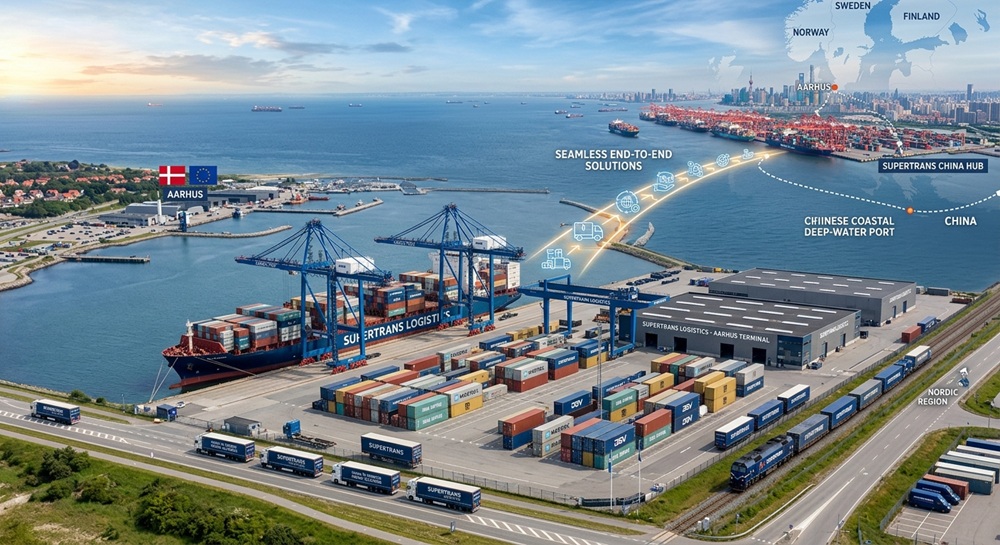
Leveraging all the advantages of Aarhus Port requires a logistics partner that knows the port inside out. Supertrans Logistics specialises in China-to-Denmark trade routes, with deep expertise in Aarhus Port operations, customs procedures and intermodal distribution across the Nordic region. We work as your extended logistics team to maximise the value you get from the Aarhus gateway.
Our Aarhus Port Services
- Sea Freight (FCL & LCL): Competitive rates for both full container and less-than-container loads from all major Chinese ports to Aarhus. Direct services, reliable schedules and transparent all-in pricing.
- Customs Clearance: In-house customs brokerage with expert knowledge of Danish regulations and Aarhus port procedures. Fast clearance, correct classification and duty optimisation.
- Port Drayage: Efficient collection and delivery of containers to and from Aarhus port terminals, with no hidden charges.
- Intermodal Distribution: Seamless rail and road distribution from Aarhus to destinations across Denmark, Scandinavia and the Baltic region.
- Warehousing & Fulfillment: Warehousing options in the Aarhus area for storage, order fulfilment and value-added services.
- Amazon FBA Prep: FBA shipment preparation, labelling and delivery to Amazon fulfilment centres across Denmark and the Nordics.
The Supertrans Advantage
Why choose Supertrans for your Aarhus shipments?
- China-Denmark specialists: We focus exclusively on trade between China and Denmark / Scandinavia. We know the routes, the ports, the regulations and the players.
- End-to-end service: From factory pickup in China to final delivery in the Nordics, we handle every stage. One point of contact, one invoice, full visibility.
- No hidden fees: All charges are confirmed upfront before shipment. No surprise surcharges, no last-minute add-ons. The price we quote is the price you pay.
- 100% reliable: Over a decade of industry experience means we deliver consistent, dependable service you can count on shipment after shipment.
- Stress-free shipping: We manage every detail of the shipping process, so you can focus on your business instead of logistics.
- 24/7 support: Our customer service team is available around the clock to answer questions, provide updates and resolve issues.
Whether you ship one container a month or dozens, whether you import industrial goods or consumer products, Supertrans Logistics tailors solutions to your specific requirements. We don’t believe in one-size-fits-all. We take the time to understand your business, then design the optimal logistics solution leveraging Aarhus Port’s full potential.
10. Best Practices: Optimise Your Supply Chain via Aarhus Gateway
To maximise the benefits of routing your Chinese imports via Aarhus Port, follow these proven best practices:
1. Consolidate Nordic Volume Through a Single Entry Point
If you currently ship to multiple Nordic countries separately, consolidate all volume through Aarhus. Use rail and feeder services for onward distribution. The economies of scale and simplification will deliver immediate cost savings and reduce management complexity.
2. Use Intermodal Rail for Long-Distance Hinterland
For destinations more than 200km from the port, use rail instead of road for the main inland leg. It is cheaper, more reliable and more environmentally sustainable. Use road only for short final delivery legs. This modal shift typically reduces inland transport costs by 15-25%.
3. Pre-Lodge Customs Declarations
Always submit customs declarations 3-5 days before vessel arrival. This allows customs to process the declaration while the ship is at sea. When the vessel docks, your cargo is already cleared and can be released immediately. This cuts port dwell time to a minimum and avoids potential demurrage charges.
4. Match Shipment Size to Optimal Mode
Use LCL for smaller shipments under 15 CBM, and FCL for larger volumes. For cargo volumes around the break-even point, get quotes for both options and compare total all-in cost. Don’t default to one mode out of habit – regularly review which is most cost-effective for your current shipment sizes.
5. Plan Around Port Schedules
Align your production and shipping schedules with the fixed weekly sailing dates from China to Aarhus. This allows you to plan precisely, minimise waiting time and maintain consistent inventory replenishment cycles. Reliable fixed schedules are one of Aarhus’ great advantages – make the most of them.
6. Work with a Port-Specialist Forwarder
Choose a freight forwarder with specific, deep experience of Aarhus Port and Nordic distribution. Generic forwarders that cover every port cannot match the local expertise, relationships and efficiency of a specialist. The right partner will unlock additional savings and speed that generalists cannot deliver.
Quick Optimisation Checklist
- ✅ All Nordic cargo routed via single Aarhus entry point
- ✅ Rail used for long-distance inland distribution
- ✅ Customs declarations pre-lodged before arrival
- ✅ FCL/LCL mode selection reviewed regularly
- ✅ Production aligned with fixed sailing schedules
- ✅ Specialist China-Nordic forwarder appointed
11. Future Outlook & Next Steps for Your Business
Aarhus Port’s position as the leading Nordic gateway is only set to strengthen in coming years. Ongoing expansion of the port itself, electrification of the rail network, growth in Baltic trade and the continuing shift of ocean cargo away from congested central European hubs all point to increasing volumes flowing through Aarhus. For Chinese importers, getting established now positions you to take full advantage of this growth trajectory.
The Nordic market will continue to grow in importance for Chinese exporters. High purchasing power, stable economies, growing e-commerce adoption and ongoing industrial demand create strong opportunities across sectors. But success in this market requires efficient, reliable and cost-competitive logistics. Choosing the right entry port is the foundation of that logistics capability.
Aarhus is no longer just Denmark’s main port. It has evolved into the central logistics hub for the entire Nordic and Baltic region. For businesses importing from China, it offers the optimal combination of direct deep-sea connectivity, efficient intermodal distribution, competitive costs and reliable operations. Companies that build their Nordic supply chains around Aarhus will hold a sustainable cost and service advantage over competitors routing through more traditional, less efficient European hubs.
The next step is to evaluate what routing via Aarhus would mean for your specific business. A professional freight audit comparing your current routing and costs against an Aarhus-based solution will quantify exactly how much you could save in both time and money. Even modest improvements in logistics costs and transit times flow directly through to improved profitability and customer satisfaction.
