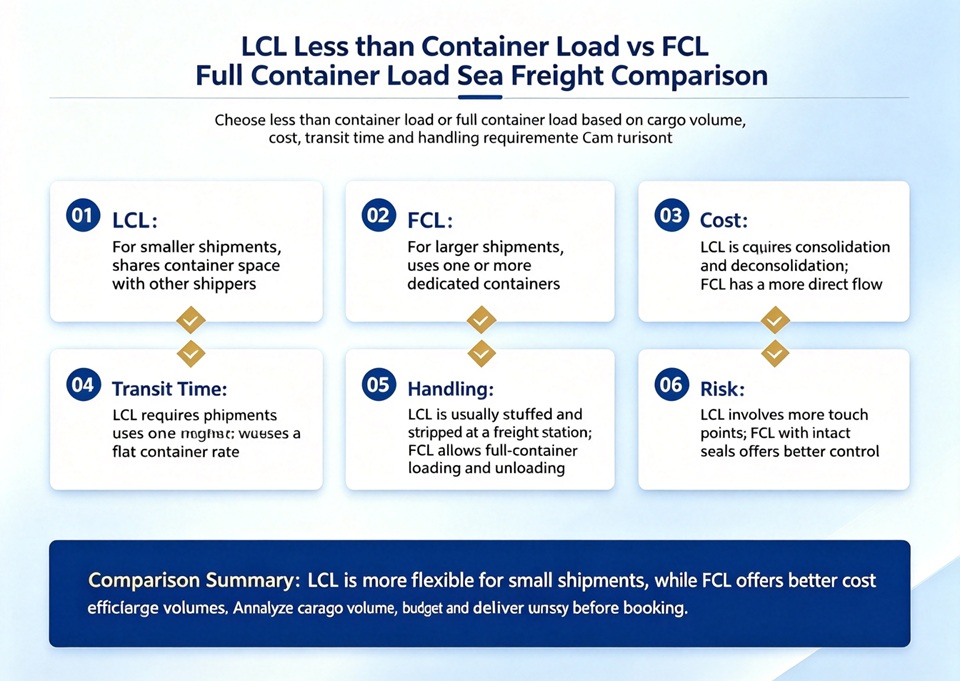
1. Why LCL vs FCL Matters for Danish Importers Sourcing From China
For Danish companies importing goods from China, selecting the right sea freight mode is one of the most impactful decisions you can make for your supply chain budget. Every year, thousands of Danish businesses source manufactured goods, consumer products, industrial components, furniture and electronics from Chinese factories. Shanghai remains the primary export hub for cargo bound for Aarhus, Denmark’s busiest container port. The vast majority of this cargo moves via one of two standard ocean shipping models: LCL (Less-than-Container Load) or FCL (Full Container Load). Yet many importers make this choice based on habit, outdated assumptions, or superficial unit-price comparisons, without fully understanding how each option impacts total landed cost, delivery reliability, cargo safety and overall supply chain efficiency.
The difference between a well-optimised freight choice and a poorly matched one can add 15-30% to your total logistics costs. For Danish businesses operating on tight product margins, this difference can mean the gap between profitable imports and loss-making shipments. Small-volume importers often default to LCL assuming it is always the cheaper option, while larger companies sometimes stick rigidly to FCL even when volumes drop, wasting money on empty container space. Both approaches leave money on the table. The reality is that LCL and FCL each have distinct economic sweet spots, risk profiles and operational trade-offs that shift depending on cargo volume, weight, value, urgency and destination requirements within Denmark.
This guide cuts through common misconceptions and delivers a detailed, Denmark-focused comparison of LCL versus FCL sea freight on the key Shanghai to Aarhus trade lane. We will break down the full cost structure of each option, compare transit times, evaluate security risks, analyse flexibility trade-offs, and identify the exact break-even volume point where switching from LCL to FCL delivers financial savings. Most importantly, we will show you how to calculate total landed cost for your specific shipments, so you can make data-driven decisions instead of relying on generic rules of thumb.
Supertrans Logistics manages thousands of containers every year moving from all major Chinese ports (Shanghai, Shenzhen, Ningbo, Guangzhou, Qingdao) to destinations across Denmark and Scandinavia. Our on-the-ground experience shows us that the majority of Danish importers are not optimising their container load strategy. Many companies overpay for freight simply because they never re-evaluate their mode choice as order volumes change. Others encounter unexpected fees at Aarhus port because they did not understand the full cost structure of the shipping option they selected. This guide will give you the framework to audit your current shipping arrangements, identify potential savings, and select the optimal mode for every shipment you book from China to Denmark.
2. What Exactly Are LCL and FCL Sea Freight? (Shanghai to Aarhus Context)
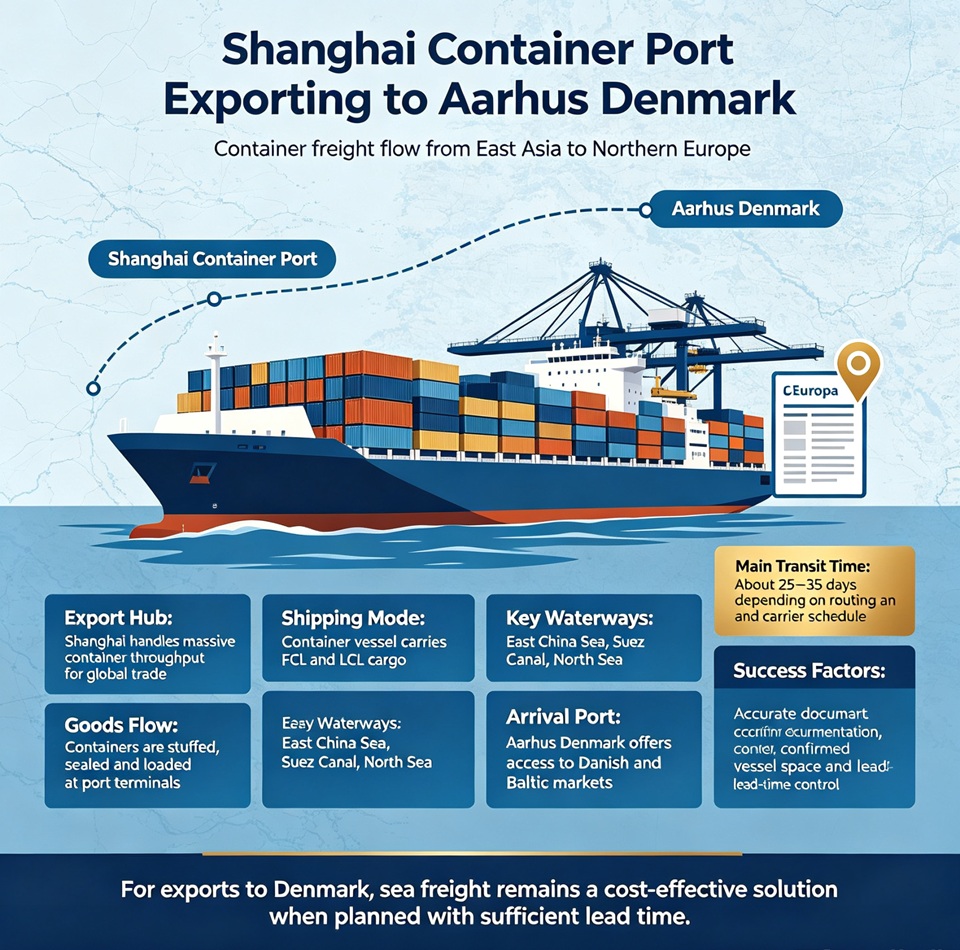
Before diving into detailed comparison, it is critical to establish clear definitions of both freight modes, specifically how they operate on the Shanghai to Aarhus route. Understanding the operational mechanics of each option makes their cost differences and performance characteristics much easier to evaluate.
FCL (Full Container Load) Definition
FCL stands for Full Container Load. Under FCL shipping, you rent an entire standard intermodal container exclusively for your cargo. The most common sizes used on the China-Denmark trade lane are 20-foot GP (General Purpose), 40-foot GP and 40-foot HQ (High Cube). You pay a flat rate for the use of the whole container, regardless of how much of the internal volume you actually fill. Once your cargo is loaded and sealed at the factory or warehouse in China, the container remains sealed all the way to your destination in Denmark. It is loaded directly onto an ocean vessel in Shanghai, sails directly to Aarhus, and is then delivered onward to your premises without being opened at intermediate points.
FCL shipments follow direct port-to-port sailing schedules. Containers are loaded at Shanghai terminal onto a liner vessel, sail directly to Aarhus, and are discharged on arrival. There is no consolidation or deconsolidation process in between origin and destination ports. This direct handling model defines most of FCL’s advantages in speed, security and simplicity.
LCL (Less-than-Container Load) Definition
LCL stands for Less-than-Container Load. Under LCL shipping, you only pay for the portion of container space your cargo occupies, measured in cubic metres (CBM) or metric tonnes. Your goods share container space with cargo from multiple other shippers also moving on the same trade lane. The freight forwarder or consolidator groups together multiple smaller shipments bound for the same destination port, fills a full container, and ships it as a single unit.
This consolidation process adds extra operational steps. For LCL shipments from Shanghai to Aarhus, your cargo is first delivered to a consolidation warehouse in Shanghai. There it is grouped with other compatible cargo, loaded into a shared container, and then moved to the port for vessel loading. Upon arrival at Aarhus port, the shared container is taken to a deconsolidation warehouse. There it is opened, individual shipments are separated, customs clearance is completed for each consignment separately, and then your goods are released for final delivery to your Danish address. This extra consolidation and deconsolidation work is the fundamental reason LCL has different cost, time and risk characteristics compared to FCL.
Key Operational Difference
FCL = your cargo stays in one sealed container from origin to destination. LCL = your cargo is handled multiple times, consolidated with other goods at origin, and separated again at destination. This difference drives almost every other comparison point between the two modes.
Both LCL and FCL are available for standard dry cargo moving between Shanghai and Aarhus. Special cargo types such as refrigerated goods, hazardous materials or out-of-gauge heavy machinery follow different pricing models and are not covered by standard LCL/FCL comparisons. For the vast majority of general cargo imported by Danish businesses from China, the choice will be between standard dry van LCL and FCL options.
3. LCL (Less-than-Container Load): Deep Dive for Denmark-Bound Cargo
LCL Cost Structure: What You Actually Pay
LCL pricing appears simple on the surface – you pay a rate per cubic metre (CBM) or per 1000kg (whichever is higher) for your cargo volume. However, the total cost of an LCL shipment from Shanghai to Aarhus includes far more than just the base ocean freight rate. Understanding the full fee structure is essential for accurate cost comparison with FCL.
Standard LCL shipment costs include:
- Origin warehouse receiving fee: Charged at the Shanghai consolidation depot for accepting and checking your cargo before consolidation.
- Export documentation fee: Covers customs declaration paperwork and export formalities in China.
- Consolidation / handling fee: Charge for loading your cargo into the shared container at the origin warehouse.
- Base ocean freight: The core sea transport cost, calculated per CBM or per tonne.
- Destination deconsolidation fee: Charged at Aarhus for unpacking the shared container and separating individual shipments.
- Destination terminal handling charge: Port fees at Aarhus applied to the consolidated container.
- Import documentation fee: Covers import entry processing and related paperwork in Denmark.
- Delivery fee: Cost of trucking your separated cargo from the deconsolidation warehouse to your final Danish address.
Many Danish importers only compare the base LCL ocean freight rate per CBM when evaluating options, and overlook the substantial origin and destination fees. These fixed fees apply to every LCL shipment regardless of how small your cargo is. For very small volumes, these fixed charges can actually make up the majority of your total LCL bill.
Advantages of LCL Shipping for Danish Importers
LCL offers compelling benefits for specific shipment profiles:
- Lower cost for small volumes: When you have insufficient cargo to fill even a 20-foot container, LCL is almost always cheaper than paying for an unused full container. You only pay for the space you actually use.
- No minimum volume commitment: You can ship as little as 1 CBM via LCL. This makes international shipping accessible for small Danish businesses, test orders, sample shipments, or replenishing slow-moving stock lines.
- Flexible frequency: LCL consolidation services depart Shanghai much more frequently than most FCL liner services for smaller volume shippers. You can ship smaller quantities more often without waiting to fill a container, supporting leaner inventory management.
- Simplified inland pricing: LCL rates often include origin and destination warehouse handling in the quoted per-CBM price, making it easier to estimate total costs for small shipments.
- Lower capital tie-up: Shipping smaller volumes more frequently reduces your average inventory holding costs and ties up less working capital in stock sitting in transit or storage.
Disadvantages & Hidden Risks of LCL Shipping
LCL also carries significant drawbacks that are often understated in initial quotations:
- Higher unit cost at volume: The per-CBM cost of LCL is significantly higher than the per-CBM equivalent cost of FCL. Once your shipment approaches 15-18 CBM, LCL starts becoming economically uncompetitive compared to a 20-foot FCL container.
- Longer transit times: The consolidation and deconsolidation process adds 3-7 days each end compared to FCL. Your cargo also waits at the origin warehouse until enough other shipments arrive to fill the container. Total door-to-door LCL transit from Shanghai to Aarhus is typically 7-12 days slower than equivalent FCL.
- Increased cargo handling: Your goods are loaded and unloaded multiple times – at factory, at origin warehouse, into container, out of container at destination, onto delivery truck. More handling equals higher risk of damage, loss, pilferage and misrouting.
- Less control & visibility: Your shipment moves as part of a consolidated container controlled by the consolidator. You have less visibility over exact sailing schedules, container status and precise delivery timelines.
- Potential for delays from other cargo: If one shipment in the consolidated container has documentation issues or fails customs inspection, the entire container can be delayed. Your cargo can be held up because of problems with other people’s goods.
- Hidden destination fees: Some LCL carriers advertise low ocean freight rates but charge inflated deconsolidation fees, terminal handling surcharges and documentation fees at Aarhus. These destination charges can come as an unpleasant surprise for Danish importers expecting all-in pricing.
LCL Critical Note for Danish Importers
Always request fully all-in LCL quotations including all origin fees, ocean freight and all Aarhus destination charges. Base-only LCL rates are highly misleading and almost always exclude substantial destination fees that become payable on arrival in Denmark.
Ideal Scenarios for Choosing LCL
LCL is the optimal choice when:
- Your cargo volume is less than approximately 12-15 CBM (below the economic break-even point for a 20ft FCL)
- You are shipping test orders, samples or small trial batches from new Chinese suppliers
- You need to replenish fast-selling stock frequently in small quantities
- Delivery time is not critically urgent and you can accept longer transit windows
- Your cargo is low-value, robust and not easily damaged by additional handling
4. FCL (Full Container Load): Deep Dive for China-Denmark Shipments
FCL Cost Structure: Understanding Full Container Pricing
FCL pricing works on a per-container basis. You pay a fixed rate for the entire container, regardless of how much or how little you fill it. This creates economies of scale – the more cargo you fit inside, the lower your per-unit freight cost. But it also means you pay for empty space if you under-fill the container.
Standard FCL shipment costs from Shanghai to Aarhus include:
- Inland trucking (origin): Transport from factory or warehouse to Shanghai container terminal.
- Export documentation fee: Chinese customs declaration and export paperwork.
- Origin terminal handling charge (OTHC): Port fees for loading the container onto the vessel at Shanghai.
- Base ocean freight rate: Core sea transport cost for the full container from Shanghai to Aarhus.
- Destination terminal handling charge (DTHC): Port fees for discharging the container at Aarhus.
- Import documentation fee: Danish import entry and customs processing fees.
- Inland trucking (destination): Transport of the sealed container from Aarhus port to your final delivery address in Denmark.
- Container detention / demurrage: Potential additional charges if you keep the container beyond the allowed free time at destination.
With FCL, most terminal and handling fees are charged per container, not per volume. This means fixed costs are spread across your entire shipment volume. The more cargo you pack in, the lower your per-unit logistics cost becomes.
Advantages of FCL Shipping for Danish Importers
FCL delivers substantial benefits for shipments of sufficient volume:
- Lower unit cost at volume: Once you have enough cargo to reasonably fill a container, FCL is significantly cheaper per CBM than LCL. The cost per unit of cargo drops steadily as you utilise more container capacity.
- Faster transit times: FCL skips the consolidation and deconsolidation steps. Containers go directly from shipper to port to vessel to destination port to consignee. Total door-to-door transit from Shanghai to Aarhus is typically 7-12 days faster than equivalent LCL service.
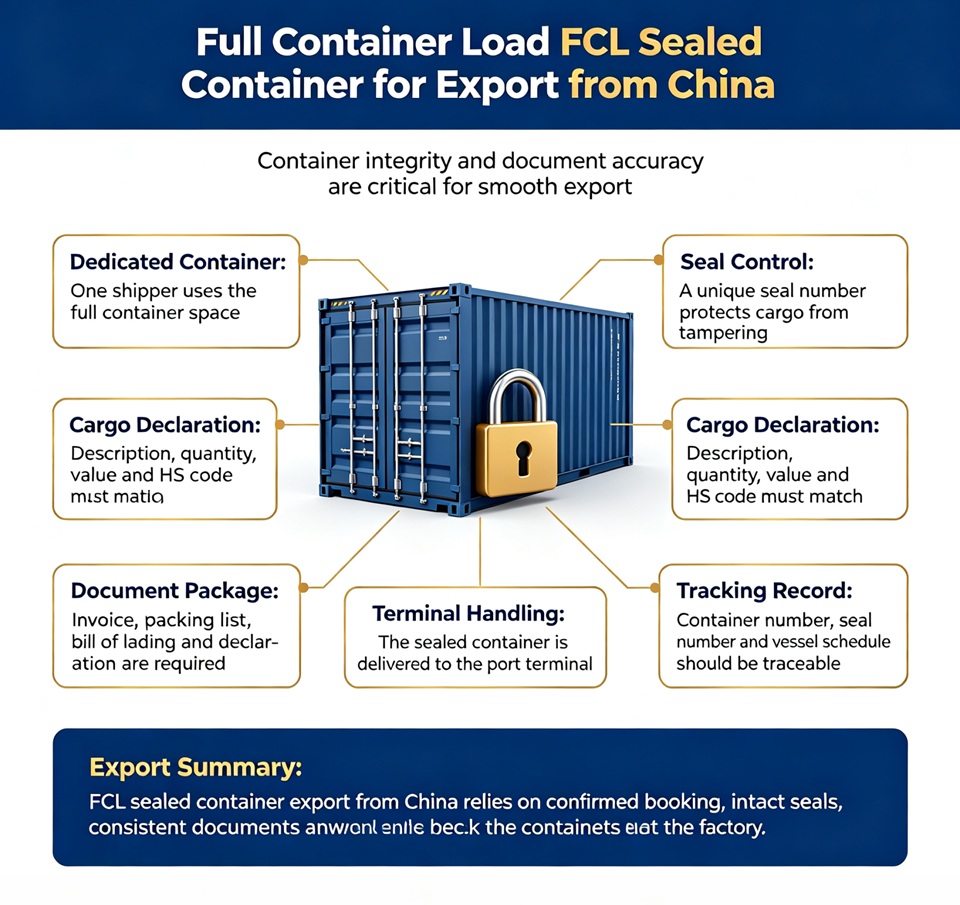
- Better cargo security: Your container is sealed at origin and remains sealed until it reaches your premises. Cargo is handled far fewer times. This dramatically reduces risk of damage, loss, theft and tampering. For high-value goods, this security advantage alone can justify choosing FCL even if you do not fully fill the container.
- Greater control & visibility: You have direct visibility of container status, exact vessel routing and confirmed sailing schedules. You know exactly when your cargo departs and arrives, enabling more accurate production and inventory planning.
- Simpler customs clearance: Single container, single documentation set, single customs entry. FCL customs clearance at Aarhus is typically faster and simpler than processing individual LCL consignments through a deconsolidation warehouse.
- Flexible loading options: You can choose to load at factory, at your supplier’s warehouse, or at a port-side facility. You control loading procedures and packing quality.
Disadvantages of FCL Shipping
FCL also has limitations that make it unsuitable for all shipment types:
- Higher absolute cost for small volumes: If you only have a few cubic metres of cargo, paying for an entire 20-foot container is extremely uneconomical. The fixed cost of the container cannot be justified for small shipments.
- Wasted space cost: If you only fill 60% of a 20ft container, you still pay 100% of the rate. Empty space is pure wasted cost. Many companies consistently ship under-filled FCL containers without realising how much money they are throwing away.
- Less frequent scheduling flexibility: You can only ship when you have enough cargo to fill a container, or when you are willing to pay for unused space. This can lead to longer order cycles and larger inventory holdings.
- Detention & demurrage risk: FCL containers come with free time limits at destination ports and for on-hire use. If clearance or delivery is delayed, detention charges can accumulate quickly and become very expensive.
- Complex cost calculation: FCL pricing has more separate fee line items. Comparing all-in FCL cost against LCL requires adding up multiple charges, which makes quick apples-for-apples comparison harder.
Ideal Scenarios for Choosing FCL
FCL is the optimal choice when:
- Your cargo volume approaches or exceeds 15 CBM (20ft container) or 30 CBM (40ft container)
- You are shipping high-value goods where security and minimal handling are priorities
- Delivery speed and schedule reliability are important for your supply chain
- You have sufficient order volume to fill containers on a regular basis
- You want maximum visibility and control over your shipment journey
5. Cost Comparison: Which Option Saves More Money for Danish Buyers?
This is the question every Danish importer wants answered: is LCL or FCL cheaper? The honest answer is: it depends almost entirely on shipment volume. Below the break-even point, LCL saves you money. Above the break-even point, FCL is significantly cheaper. The mistake most companies make is applying generic break-even rules without calculating total all-in costs for the specific Shanghai to Aarhus lane.
Per-Unit Cost Comparison (Shanghai to Aarhus)
As a baseline reference for general dry cargo on the Shanghai-Aarhus route:
- LCL: All-in per-CBM rates typically range from approximately $85–$140/CBM (depending on market conditions, weight ratio and service level).
- FCL 20ft GP: All-in container rates typically range from approximately $1,200–$1,900 per container (all origin, ocean and destination port charges included, excluding inland trucking at both ends).
- FCL 40ft GP: All-in container rates typically range from approximately $1,900–$2,900 per container. A 40ft container holds roughly double the volume of a 20ft but usually costs only 40-60% more, making it significantly more cost-efficient per CBM.
| Shipment Volume | LCL Total Est. Cost | FCL 20ft Total Est. Cost | Cheaper Option | Savings Difference |
|---|---|---|---|---|
| 5 CBM | $550 – $750 | $1,500 – $2,200 | LCL | $950 – $1,450 saved with LCL |
| 10 CBM | $1,000 – $1,400 | $1,500 – $2,200 | LCL | $500 – $800 saved with LCL |
| 15 CBM | $1,450 – $2,100 | $1,500 – $2,200 | Rough parity | Minimal difference – evaluate other factors |
| 20 CBM | $1,900 – $2,800 | $1,500 – $2,200 | FCL | $400 – $600 saved with FCL |
| 28 CBM (full 20ft) | $2,660 – $3,920 | $1,500 – $2,200 | FCL | $1,160 – $1,720 saved with FCL |
| 50 CBM (40ft) | $4,750 – $7,000 | $2,200 – $3,200 (40ft FCL) | FCL | $2,550 – $3,800 saved with FCL |
*Illustrative rates for general dry cargo Shanghai to Aarhus port-to-port equivalent. Actual rates vary with market conditions, fuel surcharges, peak seasons and service levels. Always request up-to-date all-in quotations for accurate comparison.
Why Total Landed Cost Must Be Your Comparison Metric
Comparing only base ocean freight rates is the biggest costing mistake Danish importers make. To make a valid comparison you must calculate total landed cost for each option, including every fee from origin warehouse to final delivery address in Denmark.
For LCL, make sure your quote includes: origin receiving fee, export customs fee, consolidation fee, base ocean freight, fuel surcharge, destination deconsolidation fee, Aarhus terminal handling charge, import documentation fee, and final delivery to your address.
For FCL, make sure your quote includes: origin inland trucking, export customs fee, origin terminal handling charge, base ocean freight, bunker adjustment factor, destination terminal handling charge, import documentation fee, and destination inland trucking to your address.
Only when you have complete all-in figures for both options can you make a true cost comparison. Supertrans Logistics provides transparent all-in quotations for both LCL and FCL, with no hidden fees, so you can compare confidently.
Weight Consideration for Heavy Cargo
LCL pricing uses a weight/volume ratio (often 1:1000). If your cargo is very dense and heavy, the chargeable weight may be higher than the volumetric CBM, making LCL even more expensive relative to FCL. For heavy goods, the break-even point shifts lower – FCL becomes cost-effective at smaller volumes.
6. Transit Time Showdown: LCL vs FCL from Shanghai to Aarhus
Cost is only one dimension of the comparison. Transit time reliability directly impacts your inventory planning, stock availability and customer service levels. For many Danish businesses, predictable delivery timing is worth paying a premium for.
Standard Transit Time Comparison
| Journey Stage | LCL (Shanghai to Aarhus) | FCL (Shanghai to Aarhus) |
|---|---|---|
| Origin handling & consolidation | 3-7 days | 1-2 days |
| Port to port ocean transit | 28-35 days | 26-32 days |
| Destination handling & deconsolidation | 3-7 days | 1-3 days |
| Total door-to-door | 34-49 days | 28-37 days |
On average, FCL delivers your cargo 6-12 days faster than LCL on the Shanghai to Aarhus route. This time difference is driven by two factors. First, FCL skips the consolidation wait at origin – your container goes straight to port and sails on the next available vessel. LCL cargo must wait until the consolidator has enough shipments to fill the container, which can add several days. Second, FCL skips deconsolidation at destination. The container goes straight from Aarhus port to your door. LCL cargo must first go to a warehouse to be unpacked and sorted, adding another 3-7 days before final delivery.
Reliability & Schedule Predictability
Speed is valuable, but consistency is often more important. FCL schedules are significantly more predictable than LCL. With FCL you have confirmed vessel booking, exact departure date and confirmed arrival date. Barring major port congestion or weather disruptions, FCL transit times are highly reliable.
LCL schedules are inherently less predictable. Your shipment is dependent on the consolidator’s fill rate. If other bookings are slow, your cargo may sit in the Shanghai warehouse longer than expected while the consolidator waits to fill the container. At destination, deconsolidation timing depends on customs clearance speed for all shipments in the container. A problem with any single consignment can delay release of the entire container. This variability makes LCL harder to plan around for just-in-time inventory strategies.
Cost of Time: Why Faster Transit Saves You Money
When comparing LCL vs FCL, do not overlook the financial value of faster transit. Shorter lead times mean you can place orders later, respond faster to market demand, hold less safety stock, and tie up less working capital in inventory. For fast-moving consumer goods, seasonal products or time-sensitive orders, the inventory cost savings from faster FCL delivery can easily outweigh any difference in freight cost.
Conversely, if you are shipping slow-moving stock, building inventory for future sale, or operating on long lead times anyway, the slower LCL transit may be perfectly acceptable and the cheaper option makes better economic sense.
7. Security & Cargo Safety: Comparing Risk Profiles
Cargo damage and loss represent hidden costs that many importers fail to factor into their LCL vs FCL comparison. If your goods arrive damaged, you face not just the cost of the product itself, but also lost sales, customer returns, replacement shipping costs and administration time. The difference in risk profile between LCL and FCL is substantial.
FCL Security Profile
FCL offers the highest level of cargo security for standard sea freight. Your container is loaded and sealed at origin. The seal remains intact until it reaches your delivery address in Denmark. At no point during transit is the container opened. Cargo inside is handled only once at loading and once at unloading. This minimal handling directly translates to far lower rates of damage, breakage, loss and theft.
Sealed containers also virtually eliminate risk of tampering, pilferage and cargo contamination. For high-value goods, electronics, branded products, pharmaceuticals or goods susceptible to theft, FCL is almost always the preferred option from a risk perspective. Insurance premiums for FCL cargo are also typically lower, reflecting the reduced risk profile.
LCL Security Profile
LCL involves significantly more handling points and higher inherent risk. Your cargo is handled at least four separate times between factory and final delivery. It is stored in shared warehouses, loaded alongside other people’s cargo, and transported in a container with multiple consignments. Each additional handling step increases the chance of accidental damage from dropping, crushing or improper stacking.
There is also higher risk of pilferage, loss and misrouting when cargo passes through multiple hands and shared facilities. Mixed cargo also carries contamination risk – if another shipper’s goods leak, spill or break, your cargo could be damaged as a consequence. Insurance claims are also more complex with LCL, because establishing when and where damage occurred can be difficult when multiple parties have handled the goods.
Risk Cost Calculation
When comparing options, factor in your cargo value and damage risk. If you are shipping high-value fragile goods, even a 2% higher damage rate with LCL could cost you far more than any freight cost saving. For low-value robust goods like raw materials or basic industrial parts, the higher damage risk may be an acceptable trade-off for lower LCL costs.
It is also worth noting that both LCL and FCL cargo should be covered by appropriate marine cargo insurance. But insurance is not a substitute for preventing damage in the first place. Even when insurance pays out, you still suffer disruption, administration cost and lost sales. Good cargo packaging helps mitigate risk, but cannot fully compensate for the additional handling inherent in the LCL model.
8. Flexibility, Scheduling & Supply Chain Agility
Modern supply chains demand agility. The ability to adjust shipment volumes and schedules in response to market demand is a competitive advantage. LCL and FCL offer very different flexibility profiles.
LCL Flexibility Advantages
LCL offers superior flexibility for small and variable volumes:
- Ship any quantity: You can ship 2 CBM one week and 10 CBM the next, without worrying about container fill rates. This is ideal for businesses with fluctuating order volumes or seasonal demand patterns.
- More frequent departures: Consolidation services typically depart Shanghai 2-3 times per week for Aarhus, compared to 1-2 weekly sailings for most FCL liner services. You can ship smaller lots more often.
- Lower commitment: There is no need to commit to container volumes. You can increase or decrease shipment sizes as needed without penalty or wasted cost.
- Easier to test new products: LCL lowers the barrier to testing new product lines. You can import small trial quantities without the cost and risk of booking a full container.
FCL Flexibility Advantages
FCL offers different kinds of flexibility:
- Control over timing: You decide when to ship. Once your cargo is ready, you book a container and it goes. You are not waiting for other shippers to fill a container.
- Loading flexibility: You choose where to load – factory, warehouse or port. You can take your time loading (within free time limits) and control exactly how goods are packed and secured inside the container.
- Routing control: You select the carrier, routing and service level. If you need faster transit you can upgrade to premium express services. You are not locked into the consolidator’s choice of carrier.
- Scalability: Once you ship in FCL volumes, scaling up is simple – just add more containers. Per-unit costs actually decrease as you move to larger 40ft containers.
Supply Chain Strategy Match
Your choice between LCL and FCL should align with your broader supply chain strategy. If you run a lean, fast-response supply chain with frequent small replenishments, LCL supports that model. If you operate on bulk purchasing, longer production runs and larger inventory holdings, FCL will be more cost-effective and align better with your operating rhythm.
Many successful Danish importers use a hybrid approach. They use LCL for new product launches, small volume lines and peak season top-ups, while using FCL for high-volume steady-state lines. This mixed strategy balances cost efficiency with supply chain agility. Supertrans Logistics can help you design an optimal modal mix tailored to your specific product portfolio and demand patterns.
9. Break-Even Point: When to Switch From LCL to FCL
The break-even point is the volume at which FCL becomes cheaper than LCL. This is the magic number every importer wants to know. The exact number fluctuates with market rates, fuel surcharges, peak season, cargo weight and destination specifics, but we can establish practical guidelines for the Shanghai to Aarhus trade lane.
20ft Container Break-Even
For standard dry cargo of average density, the break-even point between LCL and a 20-foot FCL container typically falls between 12 and 18 cubic metres. Below 12 CBM, LCL is almost always cheaper. Above 18 CBM, FCL is almost always cheaper. In the 12-18 CBM grey zone, the answer depends on current rate levels and the specific service details.
Important caveat: this is port-to-port comparison. When you add inland trucking costs at both ends, the picture shifts slightly. FCL inland trucking costs are per-container, while LCL delivery costs scale roughly with volume. For destinations close to Aarhus port, the break-even point stays roughly the same. For more remote inland destinations in Denmark, FCL delivery premium can push the break-even point slightly higher.
40ft Container Break-Even
The 40-foot container offers much better per-CBM economics, but you need sufficient volume to fill it. The break-even point between LCL and 40ft FCL typically falls around 25 to 32 cubic metres. Once you have consistent volumes above 30 CBM, shipping via 40ft FCL delivers dramatic cost savings compared to LCL.
There is also a secondary break-even decision between 20ft and 40ft FCL. Once you exceed roughly 22-25 CBM, it often becomes cheaper to upgrade to a 40ft container rather than squeezing into a 20ft. The 40ft costs more absolute, but offers much more space and better per-unit cost. Many companies stick to 20ft containers by habit and miss the savings available from stepping up to 40ft as volumes grow.
Non-Cost Factors That Shift the Break-Even
Cost is not the only consideration. Sometimes it makes sense to choose FCL even below the pure cost break-even point:
- High-value cargo: If damage risk or security concerns are significant, the premium for FCL may be justified well below 12 CBM.
- Time-sensitive shipments: If you need faster delivery, paying extra for FCL below break-even volume can be worth it for the time saved.
- Peak season congestion: During peak shipping periods, LCL consolidation times can blow out dramatically. FCL becomes relatively more attractive during busy periods.
- Simplified operations: For companies with limited admin resources, the simplicity of single-container FCL shipments can justify a small cost premium.
Conversely, if you are not time-sensitive and shipping low-value robust goods, you might choose LCL slightly above the theoretical break-even point because you do not mind the extra time and the absolute cost difference is small.
Quick Rule of Thumb for Shanghai → Aarhus
Under 12 CBM = go LCL. 12-18 CBM = get quotes for both and compare all-in cost. Over 18 CBM = go 20ft FCL. Over 30 CBM = consider 40ft FCL for best per-unit cost.
10. Costly Mistakes Danish Importers Make With LCL/FCL Selection
Based on years of experience helping Danish importers optimise their China freight, Supertrans Logistics has identified the most common and expensive mistakes companies make when choosing between LCL and FCL. Avoiding these errors will immediately improve your freight cost efficiency.
Mistake 1: Comparing only base ocean freight rates
This is the number one mistake. Importers see a low LCL per-CBM rate or a cheap FCL spot rate and assume they are getting a good deal. But base rates exclude terminal handling charges, documentation fees, consolidation fees, trucking costs and numerous other surcharges. By the time all fees are added, the supposedly cheap option can end up being more expensive. Always compare total all-in cost door-to-door, not just headline rates.
Mistake 2: Assuming LCL is always cheaper for small shipments
While LCL is usually cheaper for very small volumes, it is not universal. Sometimes special FCL promotional rates make a 20ft container cheaper than LCL even at 10-12 CBM. Market conditions fluctuate. Never assume – always get both options quoted and compare. During periods of very low FCL rates, the break-even point can drop to surprisingly low volumes.
Mistake 3: Ignoring cargo weight
LCL pricing is based on volumetric weight, charging whichever is greater between actual volume and actual weight. For dense heavy cargo like machinery, metal parts or tiles, the chargeable weight can be significantly higher than the CBM volume. This makes LCL much more expensive than it first appears. Heavy cargo often reaches FCL break-even at much lower volumes than light cargo. Always calculate chargeable weight when evaluating LCL.
Mistake 4: Underestimating total LCL transit time
Many importers plan based on quoted ocean transit time and forget to add consolidation and deconsolidation days. Quoted LCL transit times often only cover port-to-port sailing. The total door-to-door time is much longer. This causes missed production deadlines, stock-outs and disappointed customers. Always confirm total end-to-end timeline, not just sea days.
Mistake 5: Shipping under-filled FCL containers out of habit
Companies that normally ship full containers often continue booking FCL even when order volumes drop. They ship containers that are only 50-60% full, paying full price for half the cargo. This is pure wasted money. If volumes drop below break-even, switching to LCL for those shipments delivers immediate cost savings with no compromise on service quality.
Mistake 6: Overlooking detention & demurrage costs for FCL
FCL containers come with free time at destination port (usually 3-7 days). If customs clearance or delivery takes longer, detention charges start accruing daily. These charges can mount up surprisingly fast. Importers that consistently experience clearance delays can find unexpected detention charges erasing all the cost benefits of FCL. If you know clearance will be slow, LCL may actually work out cheaper because deconsolidation warehouses include longer free storage periods.
Mistake 7: Not re-evaluating as business grows
Many companies start with LCL when they are small and never revisit the decision as their import volumes grow. They continue shipping LCL year after year, massively overpaying on freight because no one ever does the break-even calculation. As your order volumes increase, there comes a point where switching to FCL cuts your freight cost per unit by 30-50%. Regularly auditing your freight mode choice is one of the easiest ways to reduce logistics costs.
11. How Supertrans Logistics Optimises Your China-Denmark Sea Freight
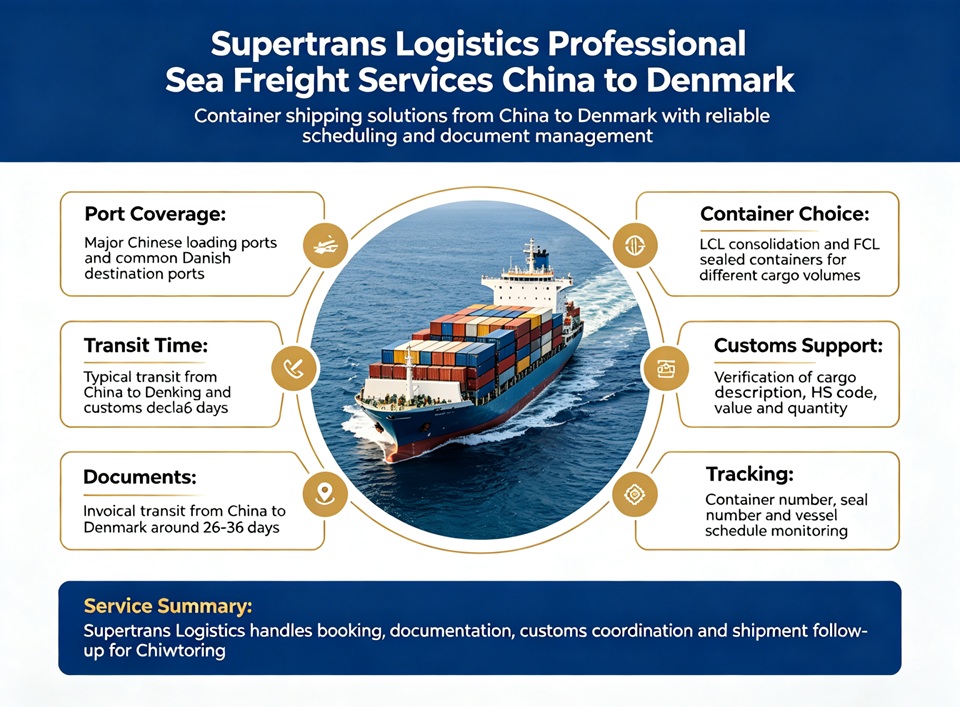
Choosing the right balance of LCL and FCL is only part of the equation. Working with an experienced freight forwarder that specialises in China-Denmark trade lanes ensures you get the best rates, most reliable services and proactive supply chain support. Supertrans Logistics has been helping Danish importers optimise their sea freight from China for over a decade, with deep local expertise at both ends of the supply chain.
Transparent Pricing, No Hidden Fees
We believe in honest, all-inclusive pricing. When you request an LCL or FCL quote from Supertrans, you receive a complete breakdown of all charges. There are no hidden fees, no surprise surcharges and no last-minute add-ons. All costs are confirmed upfront before shipment, so you can budget accurately and compare options with confidence. Our No Hidden Fee promise is one of the reasons so many Danish companies trust us with their China imports.
Expert Mode Optimisation Advice
We do not just book freight – we proactively advise you on the optimal shipping mode for every shipment. Our logistics experts analyse your cargo volume, weight, value, urgency and delivery requirements, and recommend whether LCL or FCL will deliver the best overall value for your specific situation. We will tell you honestly when FCL will save you money, and when LCL is the better choice. Our goal is to minimise your total logistics cost, not maximise our freight revenue.
Comprehensive Service Portfolio
Beyond LCL and FCL sea freight, Supertrans offers a complete range of logistics services to support your China-Denmark supply chain:
- Sea Freight: Both LCL and FCL services from all major Chinese ports (Shanghai, Shenzhen, Ningbo, Guangzhou, Qingdao) to Aarhus and across Denmark. We also handle out-of-gauge, roll-on/roll-off and break bulk cargo.
- Air Freight: Fast and secure air freight services for time-sensitive shipments, with both scheduled and deferred options to balance speed and cost.
- Express Services: Reliable express delivery for urgent parcels and documents via DHL, UPS and FedEx networks.
- Warehousing & Storage: Secure warehousing solutions in China for consolidation, quality inspection and inventory management before shipping to Denmark.
- Land Freight: Efficient inland trucking across China and Denmark for seamless first-mile and last-mile delivery.
- Amazon FBA Shipping: Comprehensive FBA shipping solutions to streamline your e-commerce logistics to Amazon fulfilment centres in Denmark and across Scandinavia.
The Supertrans Difference
What sets Supertrans apart for Danish importers:
- 100% Reliable: Over a decade of experience in international freight means we understand the complexities of China-Denmark trade lanes and deliver consistent, professional service you can count on.
- Stress-free Shipping: We manage every aspect of the shipping process on your behalf, from export documentation in China to destination handling in Denmark, ensuring a hassle-free experience for your team.
- Global Network: Our logistics network covers over 200 countries and regions worldwide, with strong local presence in both China and Denmark.
- Professional Certification: We hold multiple international logistics certifications, demonstrating our commitment to quality, compliance and industry best practice.
- 24/7 Customer Support: Our dedicated support team is available round the clock to answer your questions, provide shipment updates, and resolve any issues that arise during transit.
Whether you ship LCL or FCL, small parcels or large container volumes, Supertrans Logistics delivers the same high standard of service, transparency and reliability. We work as your extended logistics team, not just an external supplier.
12. Final Verdict & Next Steps for Your Shipments
So which sea freight option saves more money for Danish importers? The answer depends on your specific shipment, but we can draw clear evidence-based conclusions from this analysis.
LCL saves you money when: you have small shipment volumes (typically under 12-15 CBM), you value flexibility over speed, you ship low-value robust goods, and you do not have enough volume to justify a full container. LCL makes international shipping accessible for small businesses and supports agile inventory strategies.
FCL saves you money when: your volume approaches or exceeds 15 CBM for a 20ft container, you ship high-value goods where security matters, you need faster and more reliable transit, and you have sufficient consistent volume to utilise container capacity efficiently. At volume, FCL delivers dramatically lower per-unit freight costs.
The biggest opportunity for most Danish importers is not choosing one over the other universally, but optimising mode selection shipment by shipment. Many companies default to one mode for everything, leaving significant savings on the table. The best performing import businesses match shipping mode to the specific characteristics of each order.
Action Plan for Your Business
- Audit your last 3-6 months of shipping history and calculate whether you are consistently above or below break-even volume.
- For shipments in the grey zone (12-18 CBM), get comparative LCL and FCL all-in quotes for your next shipment.
- Factor in non-cost impacts: transit time value, cargo damage risk, and administration workload.
- Consider a mixed strategy: FCL for high-volume lines, LCL for low-volume lines and top-ups.
- Review your mode selection quarterly – market rates and your own volumes change over time.
At the end of the day, the cheapest option is not always the best option for your business. The best option is the one that delivers the optimal balance of cost, speed, reliability and risk for your specific supply chain needs. Making that judgement correctly requires experience, data and understanding of both shipping options in depth.
Supertrans Logistics helps Danish importers make these optimised decisions every day. We provide transparent all-in pricing, expert mode advice, and reliable end-to-end shipping services from China to Denmark. Whether you need LCL, FCL, air freight or a combination of services, we tailor solutions to your business requirements.
