1. Why Danish Customs Compliance Matters for Chinese Importers
Denmark is one of the most open and efficient trading economies in Europe, and an increasingly important gateway for Chinese goods entering the Nordic and wider EU market. Every year, thousands of Danish businesses import manufactured goods, electronics, furniture, industrial components and consumer products directly from factories across China. Shanghai, Shenzhen, Ningbo and Guangzhou serve as the main departure ports, with most sea cargo arriving at Aarhus or Copenhagen before being distributed across Denmark and Scandinavia. But while the commercial opportunity is enormous, many importers underestimate how critical proper customs and VAT compliance is to the profitability and reliability of their supply chain.
Customs clearance is not just an administrative formality. Getting it wrong leads to delayed shipments at Danish ports, unexpected duty bills, substantial financial penalties, cargo storage charges that accumulate daily, and even seizure of goods in severe cases. For Danish businesses importing from China, customs issues are one of the single largest causes of supply chain disruption. Many companies focus purely on negotiating low ex-factory prices with Chinese suppliers and overlook the fact that duties, VAT and clearance costs can add 25-40% to your total landed cost. Equally damaging, clearance delays of just a few days can lead to missed production deadlines, stock-outs and lost customer sales.
The Danish tax and customs authority, SKAT, administers all import controls with a high degree of digitalisation and strong enforcement. Danish customs procedures operate within the wider EU customs union framework, but also include specific national rules around VAT deferment, duty relief schemes and e-commerce import rules that apply specifically to goods entering Denmark. Understanding both the EU-level framework and the Danish national specifics is essential for compliant and cost-effective importing.
Supertrans Logistics has supported Danish importers with China-origin cargo for over a decade. We handle thousands of customs entries every year through Aarhus and Copenhagen ports, for everything from full container commercial cargo to small B2C e-commerce parcels. Our experience shows us that most customs problems are entirely avoidable with proper preparation, correct documentation and expert guidance. This comprehensive guide walks you through everything you need to know about Danish customs duties, import VAT, VAT deferment schemes, clearance procedures, B2B and B2C differences, and the most common costly mistakes to avoid. Whether you are an experienced importer or bringing your first shipment from China to Denmark, this guide will help you reduce costs, avoid delays and keep your supply chain running smoothly.
2. The Danish Customs Framework for Imports from China
Denmark is a full member of the European Union Customs Union. This means that once goods are cleared for free circulation in Denmark, they can move freely to other EU countries without further customs formalities. For importers, this makes Denmark an excellent staging point for serving the wider Nordic and Northern European market. But it also means that import rules are largely harmonised at EU level, with Denmark applying the EU Common Customs Tariff (TARIC) to all goods imported from non-EU countries such as China.
Key Authorities & Entry Points
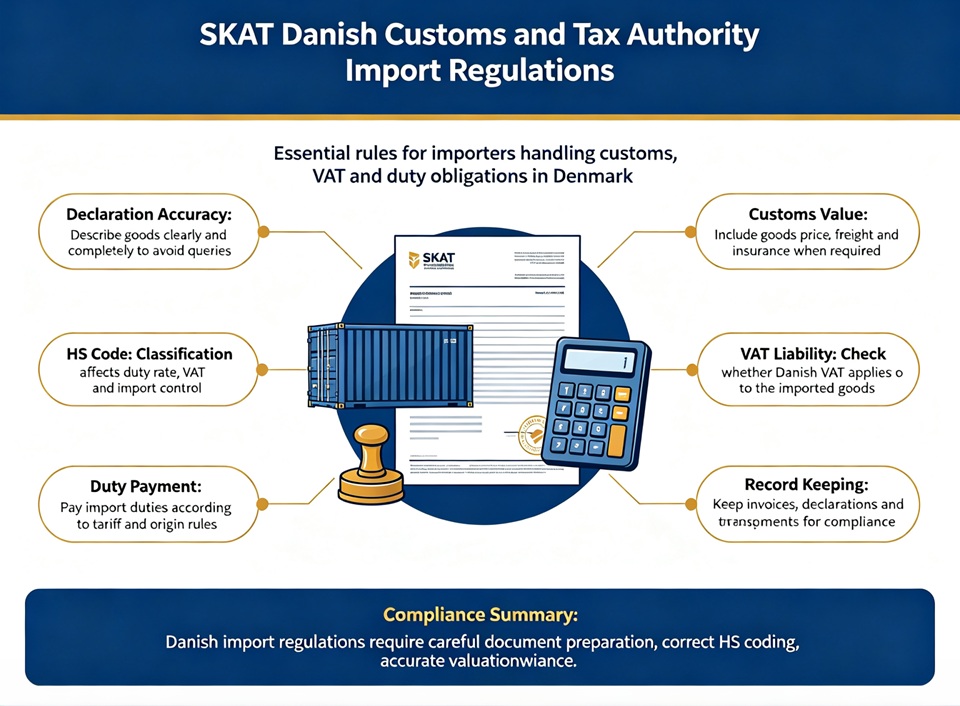
SKAT (Skatteforvaltningen) is the Danish Tax and Customs Administration. It is responsible for collecting import duties, excise duties and import VAT, as well as enforcing customs controls, trade sanctions and product safety regulations. All import declarations into Denmark are submitted to SKAT electronically via the Danish Customs Declaration System.
For sea freight from China, the two primary entry ports are:
- Port of Aarhus: Denmark’s largest container port, handling the majority of containerised imports from Asia. It has efficient modern customs facilities and fast clearance times for standard cargo.
- Port of Copenhagen: The capital’s port handles significant import volumes, particularly for cargo destined for the Copenhagen metropolitan area and southern Sweden via the Øresund link.
Air freight from China typically arrives at Copenhagen Airport (CPH), which has dedicated air cargo customs facilities. For smaller parcels and express shipments, clearance often happens directly at the express courier’s bonded facility.
Core Customs Principles for Non-EU Imports
All goods arriving in Denmark from China are subject to the following core rules unless a specific relief or suspension scheme applies:
- All goods must be declared to customs at the point of entry into Denmark (or another EU member state if cleared there).
- Goods are classified according to the Combined Nomenclature (CN) / Harmonized System (HS) code, which determines the applicable duty rate.
- Customs value is calculated based on the transaction value of the goods, plus transport and insurance costs to the EU border (CIF value).
- Import duty is calculated on the customs value at the rate applicable to the goods’ classification.
- Import VAT is calculated on the sum of customs value + import duty + any other applicable charges.
- All duties and VAT normally become payable at the point of release into free circulation.
Important Note for Chinese Importers
China is treated as a non-EU third country. There is no free trade agreement between China and the EU/ Denmark, so standard most-favoured-nation (MFN) duty rates apply to most goods. Certain product categories may also be subject to additional anti-dumping duties, countervailing duties or safeguard measures, which we cover in detail later in this guide.
While the rules may appear straightforward, practical application is often complex. Classification disputes, valuation challenges, origin verification and product safety checks can all create delays and additional costs. Working with an experienced freight forwarder and customs broker like Supertrans Logistics ensures that your declarations are correct first time, minimising the risk of hold-ups and unexpected charges.
3. HS Classification & Customs Duties: What You Pay
Customs duty is the first major import cost you need to calculate when bringing goods from China into Denmark. The amount of duty you pay depends almost entirely on how your goods are classified under the Harmonized System (HS) code.
Understanding HS & CN Classification
The Harmonized Commodity Description and Coding System (HS) is a global standard product classification system. The first 6 digits of the code are the same in all countries. The EU adds two more digits to create the Combined Nomenclature (CN) code, which is used for customs declarations across all EU member states including Denmark. National tariff codes may add further digits for specific national measures.
Getting classification right is absolutely critical. Different HS codes carry different duty rates, which can range from 0% for certain goods to well over 10% for others. Even small differences in classification can lead to very different duty bills. Many importers try to guess their HS code or rely on their Chinese supplier’s suggestion, which is often incorrect for EU import purposes. Misclassification is one of the most common causes of customs penalties and delayed clearances in Denmark.
How Customs Duties Are Calculated
Import duty is calculated as a percentage of the customs value of the goods. The customs value is based on the price actually paid or payable for the goods, plus all costs incurred to bring the goods to the port of entry into Denmark – including inland transport in China, ocean freight, cargo insurance, loading charges and port fees. This is essentially the CIF (Cost, Insurance, Freight) value at the Danish port of arrival.
Duty formula:
Import Duty = Customs Value (CIF) × Applicable Duty Rate
Common Duty Rates for Chinese Imports into Denmark
Duty rates vary enormously by product category. As a reference guide, typical MFN duty rates for commonly imported goods from China include:
| Product Category | Typical HS Chapter | Standard Duty Rate |
|---|---|---|
| Electronics & electrical goods | Chapter 84-85 | 0% – 4.7% |
| Clothing & textiles | Chapter 61-62 | 10% – 12% |
| Furniture | Chapter 94 | 0% – 2.7% |
| Toys & games | Chapter 95 | 0% – 4.7% |
| Steel & metal products | Chapter 72-73 | 0% – 7% |
| Plastic products | Chapter 39 | 4.2% – 6.5% |
| Machinery & equipment | Chapter 84 | 0% – 4.2% |
| Footwear | Chapter 64 | 8% – 17% |
*Indicative rates only. Exact duty depends on precise product classification, material composition and function. Always verify the exact rate for your specific HS code before importing.
Additional Duties & Trade Remedies
This is an area where many Chinese importers encounter unpleasant surprises. Beyond standard MFN duties, certain product categories from China are subject to additional trade remedy measures imposed by the EU. These can dramatically increase your total duty cost:
- Anti-dumping duties: Applied to goods deemed to be dumped into the EU market at below normal value. Many products from China are affected, including certain steel products, aluminium, solar panels, ceramic tiles, bicycles, solar glass and more. Anti-dumping duties can be as high as 20-70% on top of normal duty.
- Countervailing duties: Applied to goods that benefit from Chinese government subsidies. Often applied alongside anti-dumping measures on the same products.
- Safeguard measures: Temporary quantitative restrictions or additional duties applied to specific product categories during periods of surging imports.
These additional duties are product-specific and change regularly as EU trade policy evolves. It is essential to check whether your products are affected before you commit to large orders from China. Many importers have suffered massive unexpected duty bills because they were unaware of anti-dumping measures applying to their goods. Supertrans Logistics monitors trade measures continuously and can advise you whether your product category is affected.
4. VAT Rules for Imports into Denmark from China
Value Added Tax (VAT) is usually the single largest import cost when bringing goods from China into Denmark. For most products, import VAT will be significantly higher than the actual customs duty bill. Understanding how import VAT works is therefore essential for accurate landed cost calculation.
Standard Danish VAT Rate
Denmark applies a standard VAT rate of 25% on most imported goods. This is one of the highest standard VAT rates in Europe. There are reduced rates of 0% for certain goods such as books, newspapers and some medical supplies, and 12.5% for some food items, but the vast majority of industrial and consumer goods imported from China fall under the standard 25% rate.
How Import VAT Is Calculated
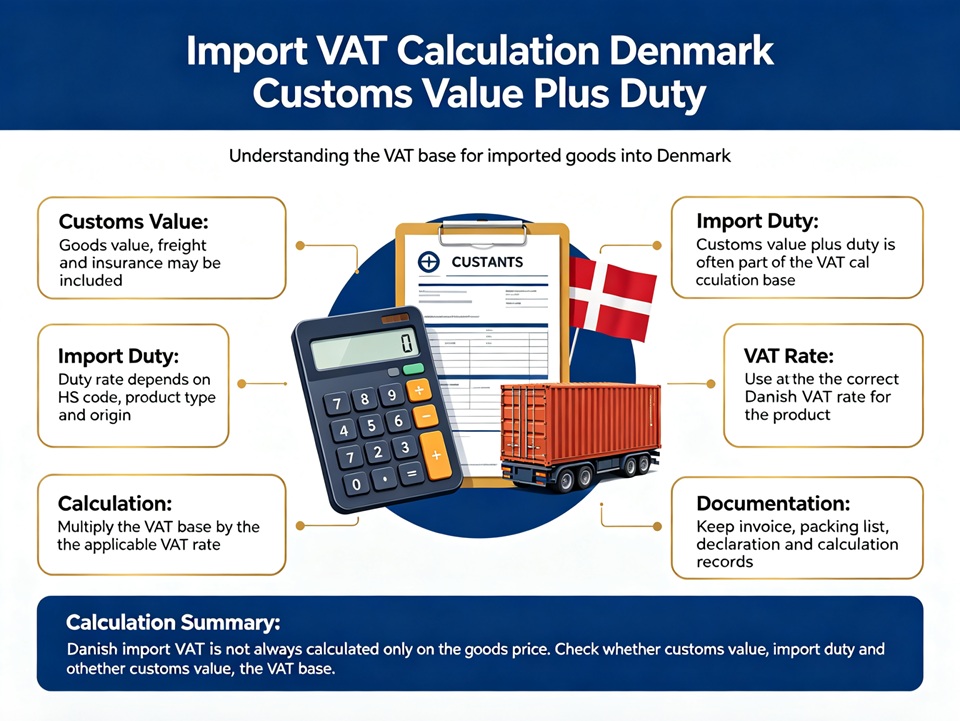
Import VAT is not calculated on the invoice value of the goods alone. It is applied to the full taxable amount for import purposes, which includes:
- Customs value of the goods (CIF value at Danish border)
- All applicable customs duties
- Any other taxes, fees or charges levied on import
- Transport and insurance costs up to the first destination inside Denmark (if not already included in customs value)
Import VAT formula:
Import VAT = (Customs Value + Import Duty + Other Charges) × 25%
This stacking effect is important. Because VAT is charged on top of duty, the effective total import tax burden is higher than just adding duty rate and VAT rate. For example, if you have goods with 10% duty, the total combined import levy is not 35%, but effectively 37.5% of the original customs value (10% duty + 27.5% VAT on the duty-inclusive value).
Common VAT Calculation Mistake
Many importers calculate VAT only on the product invoice value and forget to add freight, insurance and duty into the VAT base. This leads to significant under-estimation of total landed cost. Always calculate VAT on the full duty-paid CIF value to get an accurate figure.
VAT Recovery for Danish Businesses
The important caveat for B2B importers is that import VAT is generally recoverable. If your business is VAT-registered in Denmark and you import goods for business purposes, you can typically deduct the import VAT paid as input VAT on your regular VAT return. This means that for VAT-registered businesses, import VAT is effectively a cash flow cost rather than a permanent cost – you pay it at import and then reclaim it later.
However, the timing difference between paying VAT at import and recovering it on your VAT return can create significant cash flow pressure, particularly for businesses importing large volumes or high-value goods. This is why VAT deferment schemes are so valuable for active importers. We cover these schemes in detail in the next section.
Note that if you are not VAT-registered in Denmark, or if you import goods for non-business purposes, import VAT becomes a permanent cost that you cannot recover.
Non-recoverable Import Costs
Unlike VAT, customs duties are almost never recoverable. They represent a permanent cost added to your goods. This is why correct classification and duty optimisation is so important – duty savings drop directly to your bottom line, whereas VAT savings are primarily cash flow benefits.
5. VAT Deferment & Suspension: Improve Cash Flow
For regular importers, paying import VAT upfront at the border can tie up enormous amounts of working capital. Fortunately, Denmark offers one of the most generous VAT deferment systems in Europe, allowing qualifying businesses to delay payment of import VAT and significantly improve cash flow.
Danish VAT Deferment Account System
The Danish VAT deferment scheme allows approved businesses to defer payment of import VAT from the point of import until the 25th day of the following month. Instead of paying VAT immediately when your goods clear customs, the amount is debited from your deferment account on a monthly basis. You then declare and recover the VAT on your normal VAT return in the usual way.
The benefit is substantial. Instead of paying VAT at import and waiting potentially 4-6 weeks to recover it on your VAT return, you effectively get an extra 30+ days of credit. For businesses importing millions of kroner worth of goods from China every month, this improves working capital by hundreds of thousands of kroner and reduces financing costs significantly.
Eligibility & How to Apply
To use the VAT deferment scheme you must:
- Be VAT-registered in Denmark
- Have regular import activity (there is no strict minimum volume threshold, but the scheme is intended for active importers)
- Have a good compliance record with SKAT
- Provide a financial guarantee if required (based on your expected monthly import VAT liability)
- Submit applications through SKAT’s online portal
Approval is not automatic and can take several weeks to process. Once approved, you receive a deferment account number that is quoted on all your import declarations. It is important to ensure that your customs broker always uses your correct deferment account number on every declaration, otherwise VAT will be charged immediately at import.
Customs Warehousing & Duty Suspension
Beyond VAT deferment, there are additional schemes that allow you to suspend both duty and VAT entirely:
- Customs Warehouse: Goods can be stored in an approved customs warehouse in Denmark without payment of import duty or VAT. Duty and VAT only become payable when goods are released into free circulation. If goods are re-exported outside the EU, no duty or VAT is ever payable. This is ideal for businesses that import goods for distribution across Europe or for re-export.
- Inward Processing Relief: If you import goods from China to process, repair or modify them and then re-export the finished products, you may be eligible for relief from import duty and VAT.
- End-use Relief: Certain goods imported for specific approved uses may qualify for reduced or zero duty rates.
Is VAT Deferment Right for Your Business?
VAT deferment is almost always worthwhile for any business importing regularly from China. The cash flow benefit is usually more than worth any small administration cost. Customs warehousing is more specialised and best suited to businesses with significant storage requirements, pan-European distribution, or re-export activity.
Supertrans Logistics works closely with Danish importers to evaluate which relief schemes are appropriate for their business model. We can advise on eligibility, help with application processes, and ensure that your import declarations correctly apply the relevant relief codes to maximise your cash flow benefits.
6. Step-by-Step Customs Clearance Process for China Shipments
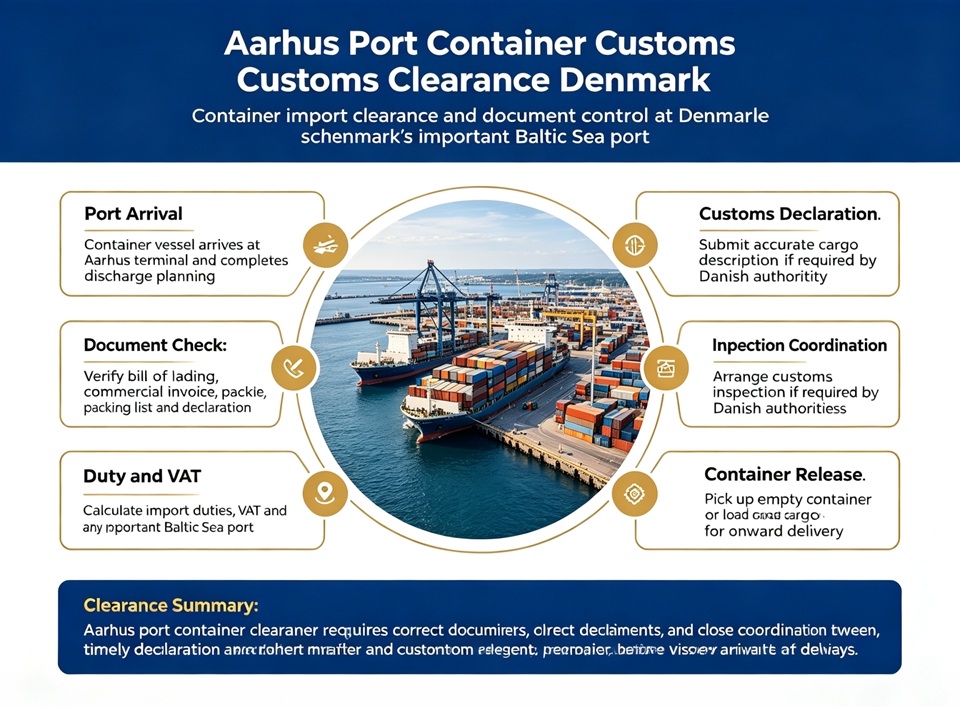
Understanding the end-to-end clearance process helps you plan timelines accurately and avoid delays. For sea freight shipments from China arriving at Aarhus or Copenhagen, the customs clearance process follows this standard sequence:
Step 1: Pre-arrival Documentation Preparation
Clearance actually begins before the ship even arrives in Denmark. Your freight forwarder or customs broker prepares all required documentation in advance. For standard commercial imports from China, you will need:
- Commercial Invoice: Detailed invoice from your Chinese supplier showing description of goods, quantity, value, currency, trade terms and buyer/seller details. Must be in English or Danish.
- Packing List: Detailed breakdown of contents per package, weights and dimensions.
- Bill of Lading (Sea Waybill): Transport document issued by the shipping line, serving as proof of carriage and ownership.
- Certificate of Origin: Document certifying the country of origin of the goods. Required for certain duty regimes and trade compliance checks.
- Insurance Certificate: If goods are shipped CIF, evidence of cargo insurance.
- Regulatory Certificates: If applicable – CE marking, test reports, safety certificates, phytosanitary certificates, etc.
SKAT operates a fully electronic declaration system. All import declarations are submitted digitally, typically several days before the vessel arrives in Denmark. Pre-lodging declarations allows customs to process the declaration in advance so that goods can be released quickly upon arrival.
Step 2: Arrival & Declaration Lodgement
When the vessel arrives at Aarhus or Copenhagen port, the shipping line notifies customs of the cargo arrival. The import declaration is formally submitted if not already pre-lodged. The declaration includes all classification, valuation and origin information, plus calculation of duties and VAT payable.
Step 3: Customs Risk Assessment
Danish customs uses an automated risk analysis system to select declarations for control. Most low-risk, regular importers’ declarations are processed automatically with no physical check. A small percentage are selected for:
- Documentary check: Customs request additional documentation to verify the declaration.
- Physical inspection: The container is opened and goods are checked against the declaration. Inspections may cover classification, origin, value, product safety or prohibited goods.
The risk of inspection depends on factors including product category, importer compliance history, origin country and declaration accuracy. China-origin goods may have slightly higher inspection rates for certain product categories due to intellectual property and product safety concerns.
Step 4: Duty & VAT Payment (or Deferment)
If the declaration is accepted and no inspection is required, customs calculate the final duty and VAT liability. If you have a VAT deferment account, the VAT amount is deferred to your monthly statement. If not, both duty and VAT must be paid before goods are released. Duty is always payable at release unless another relief scheme applies.
Step 5: Release & Delivery
Once payment is confirmed (or deferment authorised), customs issue a release notification. The container can then be collected from the port terminal and delivered to your warehouse or final destination. The entire process from vessel arrival to release typically takes 1-3 working days for standard FCL cargo with correct documentation and no inspection. LCL cargo may take 2-5 days due to additional deconsolidation steps.
Key Time-Saving Tip
Pre-lodge your customs declaration 3-5 days before vessel arrival. This gives customs time to process the declaration in transit. When the ship docks, your cargo is already cleared and can be released immediately. This can save 1-2 days of port time and avoid potential demurrage charges.
7. B2B vs B2C Import Differences: Key Distinctions
Customs and VAT rules apply very differently depending on whether you are importing goods for business-to-business (B2B) commercial purposes or business-to-consumer (B2C) direct-to-customer e-commerce sales. Many importers moving into e-commerce discover too late that the rules for parcels are completely different from standard commercial cargo.
B2B Commercial Imports
Standard B2B imports are what most people think of when importing from China. This is when a Danish business imports goods from a Chinese supplier for business purposes – for resale, production or internal use. Key characteristics:
- Full customs declaration required for every shipment
- Import duty payable at full rate based on HS classification
- Import VAT at 25% payable (or deferred via deferment account)
- VAT is recoverable as input tax for VAT-registered businesses
- Requires full commercial documentation (invoice, packing list, bill of lading)
- No low-value exemption for duty or VAT
B2B imports form the bulk of cargo arriving by sea container from China. They follow the full clearance process outlined in the previous section.
B2C E-commerce Imports
Direct-to-consumer e-commerce shipments follow a completely different set of rules designed for low-value parcels. If you sell directly to Danish consumers from China, these rules apply to your shipments:
| Shipment Value | Customs Duty | Import VAT | Notes |
|---|---|---|---|
| Below €22 (~165 DKK) | Exempt | Exempt | Full exemption for very low value gifts and small parcels |
| €22 – €150 (~165 – 1120 DKK) | Exempt | 25% VAT payable | Duty free but VAT still applies to goods in this value band |
| Above €150 (~1120 DKK) | Full duty applies | 25% VAT payable | Treated same as standard commercial import |
IOSS: The Game-Changer for B2C Sellers
The Import One-Stop Shop (IOSS) is an EU scheme that simplifies VAT for e-commerce sellers selling to consumers in the EU. If you register for IOSS (which you can do in any EU member state, including Denmark), you can charge Danish VAT at the point of sale to your customers, and then declare and pay it monthly via the IOSS portal.
The huge benefit is that goods imported under IOSS do not have import VAT charged at the border. This means parcels clear customs much faster, with no unexpected VAT charges for the customer upon delivery. This dramatically improves customer experience and reduces delivery times for B2C shipments from China to Denmark.
IOSS applies to goods valued under €150 per item. It is ideal for e-commerce sellers, dropshippers and marketplace sellers sending parcels directly to Danish consumers from China. Properly implemented, IOSS eliminates border delays and surprise VAT charges that are one of the biggest causes of cart abandonment and customer complaints in cross-border e-commerce.
B2C Common Pitfall
Many Chinese e-commerce sellers quote “duty-free delivery” to Danish customers based on the €150 duty exemption, but forget that VAT still applies. Customers then get hit with a 25% VAT charge plus a customs handling fee upon delivery, leading to bad reviews and refused deliveries. Always use IOSS if you want to offer fully pre-paid VAT delivery.
8. Costly Customs Pitfalls Chinese Importers Fall Into
Based on years of handling customs clearance for Danish importers, Supertrans Logistics has identified the most frequent and expensive mistakes businesses make when importing from China. Avoiding these pitfalls will save you money, time and administrative headaches.
Pitfall 1: Incorrect HS Classification
This is the number one cause of customs problems. Many importers use the wrong HS code, either by mistake or in an attempt to pay lower duty. SKAT has sophisticated classification verification and regularly audits import declarations. If you have used an incorrect code that understates duty, you will face back payment of underpaid duty plus interest and potential penalties of up to 50% of the underpaid amount. Even honest mistakes get penalised.
Conversely, using a code with a higher duty rate than necessary means you are overpaying duty unnecessarily. We regularly review clients’ historic imports and find that 15-20% of shipments have been classified incorrectly, usually to the importer’s disadvantage.
Pitfall 2: Under-declaring Goods Value
Some importers are tempted to declare a lower value for goods to reduce duty and VAT bills. This is customs fraud and carries very serious consequences. SKAT uses extensive valuation databases and compares declared values against standard price benchmarks for goods from China. Under-declaration is frequently detected and leads to substantial fines, back taxes and potentially criminal prosecution for serious cases. It also damages your compliance record, leading to more frequent inspections on future shipments.
Pitfall 3: Incomplete or Incorrect Documentation
Missing or incorrect documentation is the biggest cause of clearance delays. Common problems include: commercial invoices missing required details, incorrect HS codes on invoices, missing certificates of origin, missing regulatory certificates, and discrepancies between different documents. Even small inconsistencies like different product descriptions on the invoice and packing list can trigger customs queries and hold up clearance for days while the issue is resolved. Every day of delay adds port storage charges and container demurrage costs.
Pitfall 4: Unawareness of Anti-Dumping Duties
As mentioned earlier, many products from China are subject to anti-dumping or countervailing duties on top of normal customs duty. Importers often discover this only when their goods arrive in Denmark and they receive a duty bill far higher than expected. By that point it is too late to renegotiate with the supplier or cancel the order. Always check for trade remedy measures before you place your order, not after the goods ship.
Pitfall 5: Not Using VAT Deferment
Surprisingly many regular importers still do not use the Danish VAT deferment scheme. They pay VAT immediately at import every month, unnecessarily tying up large amounts of working capital. For a business importing 5 million DKK worth of goods a month from China, not using deferment means permanently tying up around 1 million DKK in VAT cash flow. That is expensive capital that could be used for business growth.
Pitfall 6: Ignoring Product Compliance Requirements
Denmark and the EU have extensive product safety, marking and compliance requirements. Goods must meet CE marking requirements where applicable, plus specific rules for electronics, toys, food contact materials, cosmetics, personal protective equipment and more. Non-compliant goods can be seized at the border, destroyed or required to be re-exported at the importer’s expense. Many Chinese suppliers are not fully aware of EU product requirements, so compliance verification is the importer’s responsibility.
Pitfall 7: No Broker or Using Inexperienced Brokers
Some businesses attempt to do their own customs declarations to save money. But customs rules are complex and constantly changing. Inexperienced declarers make mistakes that end up costing far more than any broker fee saving. A good customs broker gets declarations right first time, maximises available reliefs and minimises clearance time. The cost of professional brokerage is almost always offset by duty savings, penalty avoidance and faster clearance.
9. How Supertrans Logistics Simplifies Danish Customs Clearance
Navigating Danish customs and VAT doesn’t have to be complicated, stressful or expensive. When you partner with Supertrans Logistics for your China-Denmark shipments, you get access to expert customs brokerage built directly into your logistics service. We handle the entire clearance process on your behalf, so you can focus on your business instead of customs paperwork.
Our Customs Clearance Services
- HS Classification Advice: Our specialists classify your goods correctly according to EU/ Danish tariff codes, ensuring you pay the right amount of duty – no more, no less. We review product specifications, material composition and function to determine the most accurate and favourable valid classification.
- Duty & VAT Calculation: We provide accurate total landed cost calculations before you ship, including all duties, VAT and fees. No surprise costs upon arrival.
- Documentation Review & Preparation: We check all your shipping documentation for completeness and accuracy before departure from China, catching issues before they cause delays at Danish customs.
- Electronic Declaration Submission: We submit all customs declarations electronically via SKAT’s system, typically pre-lodged before vessel arrival for fastest possible release.
- VAT Deferment Support: We advise on deferment eligibility, help you set up your deferment account, and ensure all your declarations correctly use your deferment number to optimise cash flow.
- Duty Relief & Scheme Advisory: We identify all applicable duty relief, suspension and preferential schemes you may qualify for, and ensure you benefit from every available saving.
- Customs Inspection Support: If your shipment is selected for inspection, we handle the entire process on your behalf, coordinate with customs, and work to resolve issues as quickly as possible.
- B2C / IOSS Solutions: For e-commerce sellers, we provide full IOSS-compliant parcel import solutions for fast, hassle-free delivery to your Danish customers.
The Supertrans Advantage
What makes our customs service different from standard brokers?
- China-Denmark Specialists: We focus exclusively on trade lanes between China and Denmark / Scandinavia. We know the specific products, documentation patterns and common issues that arise with Chinese imports.
- End-to-End Integration: We handle both the international freight and the customs clearance. One point of contact, one invoice, seamless coordination between shipping and brokerage teams.
- No Hidden Fees: All our customs fees are confirmed upfront and included in your shipping quotation. No surprise brokerage charges or handling fees added later.
- Proactive Compliance: We don’t just process declarations – we proactively advise you on compliance issues, trade policy changes and duty adjustments that affect your business.
- 100% Reliable: Over a decade of experience with Danish customs means we understand how SKAT operates and what they expect. Our clearance success rate is among the highest in the industry.
- 24/7 Support: Our team is available around the clock to answer questions, resolve issues and keep your shipments moving.
Whether you ship LCL parcels, full container loads, air freight or e-commerce parcels, Supertrans Logistics delivers the same high standard of customs expertise and service quality. We work as your extended logistics and customs team, not just an external supplier.
10. Best Practices for Smooth, Cost-Effective Clearance
Follow these proven best practices to ensure your imports from China clear Danish customs quickly, correctly and at the lowest possible cost:
1. Get Professional Classification Before You Order
Don’t wait until goods are shipping to find out your duty rate. Get your products professionally classified before you finalise orders with Chinese suppliers. This lets you accurately calculate total landed cost and factor duties into your pricing and margin calculations. It also avoids nasty surprises when goods arrive.
2. Ensure Complete, Accurate Documentation
Provide your supplier with clear requirements for invoice and packing list format. Ensure all documents are consistent – same product descriptions, quantities, values and HS codes across all paperwork. Discrepancies are the number one cause of customs queries and delays. If possible, have your freight forwarder review documents before the goods leave China.
3. Declare Correctly – Don’t Under or Over Value
Always declare the actual transaction value of the goods. Include all costs such as tooling fees, royalties or assists that may need to be added to the customs value. Keep evidence of the transaction (invoices, payment records) to support the declared value if questioned. Honest, well-documented declarations almost always process faster and attract less scrutiny.
4. Use Pre-lodgement & Deferment
Always lodge declarations in advance of arrival to minimise port time. If you import regularly, set up a VAT deferment account to improve cash flow. These two simple steps will speed up clearance and reduce your working capital requirements dramatically.
5. Check for Trade Remedies & Restrictions
Before placing orders, check whether your product category is subject to anti-dumping duties, countervailing duties, quotas or import restrictions. The EU regularly updates trade defence measures, particularly regarding China. What was clear last year may now attract heavy additional duties.
6. Verify Product Compliance
Ensure your products meet all applicable EU and Danish product safety requirements, CE marking, labelling and packaging rules. Ask your Chinese supplier for test reports and compliance documentation before production, not after. Non-compliant goods get seized at the border.
7. Work With a Specialist Forwarder / Broker
The single best investment you can make is partnering with an experienced freight forwarder that specialises in China-Denmark trade and has in-house customs expertise. A good broker will save you far more money in avoided penalties, optimised duties and faster clearance than their service costs.
Quick Compliance Checklist
- ✅ HS code confirmed by professional classifier
- ✅ All commercial documents complete and consistent
- ✅ Customs value correctly stated with supporting evidence
- ✅ Product compliance / CE documentation in order
- ✅ No anti-dumping / trade remedies apply (or costed in)
- ✅ VAT deferment account set up (if regular importer)
- ✅ Declaration pre-lodged before arrival
- ✅ Experienced customs broker handling declaration
11. Final Thoughts & Next Steps for Your Imports
Danish customs and VAT rules are complex, but they are navigable with the right knowledge and support. The biggest mistake importers make is treating customs as an afterthought. Successful importing means building customs and VAT considerations into your sourcing decisions from the very beginning – before you place orders with Chinese suppliers, not after your goods are already on the water.
Understanding duty rates, correctly classifying your products, optimising VAT cash flow through deferment, ensuring documentation accuracy and working with expert brokers will all contribute to faster clearance, lower costs and fewer supply chain disruptions. For most Danish businesses importing from China, the combination of professional customs brokerage and VAT deferment delivers immediate, measurable benefits to both cost and cash flow.
The regulatory environment is also constantly evolving. EU trade policy towards China, duty rates, product safety rules and e-commerce VAT regimes all change regularly. Working with a logistics partner that stays on top of these changes ensures you remain compliant and competitive as regulations evolve.
Supertrans Logistics is here to help at every stage of your import journey. Whether you are planning your first order from China, looking to improve your current clearance processes, or seeking to reduce costs through better duty optimisation and VAT management, our team has the expertise and experience to deliver results.
