1. Executive Overview of China-Denmark Commercial Trade & Strategic Logistics Realities
The bilateral commercial alliance between the People's Republic of China and the Kingdom of Denmark represents one of the most sophisticated, high-tech, and value-intensive trade lanes in modern international commerce. Denmark—a nation recognized worldwide for its pioneering work in renewable wind energy, pharmaceuticals, maritime engineering, advanced industrial design, and high-end consumer retail—relies heavily on Chinese manufacturing capabilities to fuel its domestic economy and support its global supply networks. From raw metals, solar components, and industrial machinery to consumer electronics, apparel, medical devices, and e-commerce merchandise, billions of Euros in physical goods traverse the maritime and air routes connecting East Asia with Northern Europe every single year.
However, orchestrating international logistics between major Chinese industrial manufacturing zones—such as Shanghai, Ningbo-Zhoushan, Shenzhen, Guangzhou, Qingdao, and Tianjin—and key Danish commercial hubs including the Port of Aarhus, Port of Copenhagen, Odense, Aalborg, and Billund Airport demands an extraordinary level of operational discipline. Danish importers face an array of complex, moving targets: volatile container shipping rates, strict European Union environmental mandates, complex customs declarations managed by the Danish Customs Agency (Toldstyrelsen) and Tax Agency (SKAT), currency fluctuations, and multi-modal transit risks.
At Supertrans Logistics, our primary mission as a premier international freight forwarding partner is to protect our clients' bottom lines while accelerating their supply chain speed. Over decades of managing ocean container fleets and dedicated air cargo charters between China and Northern Europe, we have identified a persistent, costly vulnerability in international procurement: the misapplication or misunderstanding of International Commercial Terms (Incoterms).
More than 65% of international freight disputes, unexpected container demurrage bills, custom clearance holds, and uncompensated transit losses do not stem from carrier negligence; they stem directly from poorly structured purchasing contracts where the buyer and seller selected an inappropriate Incoterm. Selecting the wrong trade term can force a Danish importer to assume massive financial liabilities for accidents occurring thousands of miles away in Chinese domestic transit, or leave them vulnerable to predatory destination handling fees levied by unverified third-party logistics agents in European ports.
This master guide has been meticulously engineered for Danish procurement directors, global logistics executives, supply chain managers, and Chinese export specialists. It delivers an exhaustive, end-to-end breakdown of the Top 5 Incoterms Rules for China-Denmark Trade under the modern ICC framework. Whether you are shipping full container loads (FCL) of solar panels from Shanghai to Aarhus, managing consolidated groupage (LCL) of consumer items to Copenhagen, or dispatching time-critical electronics via air cargo from Shenzhen Pudong to Copenhagen Airport (CPH), this guide provides the definitive playbook to eliminate financial risk, maximize cost transparency, and ensure seamless delivery.
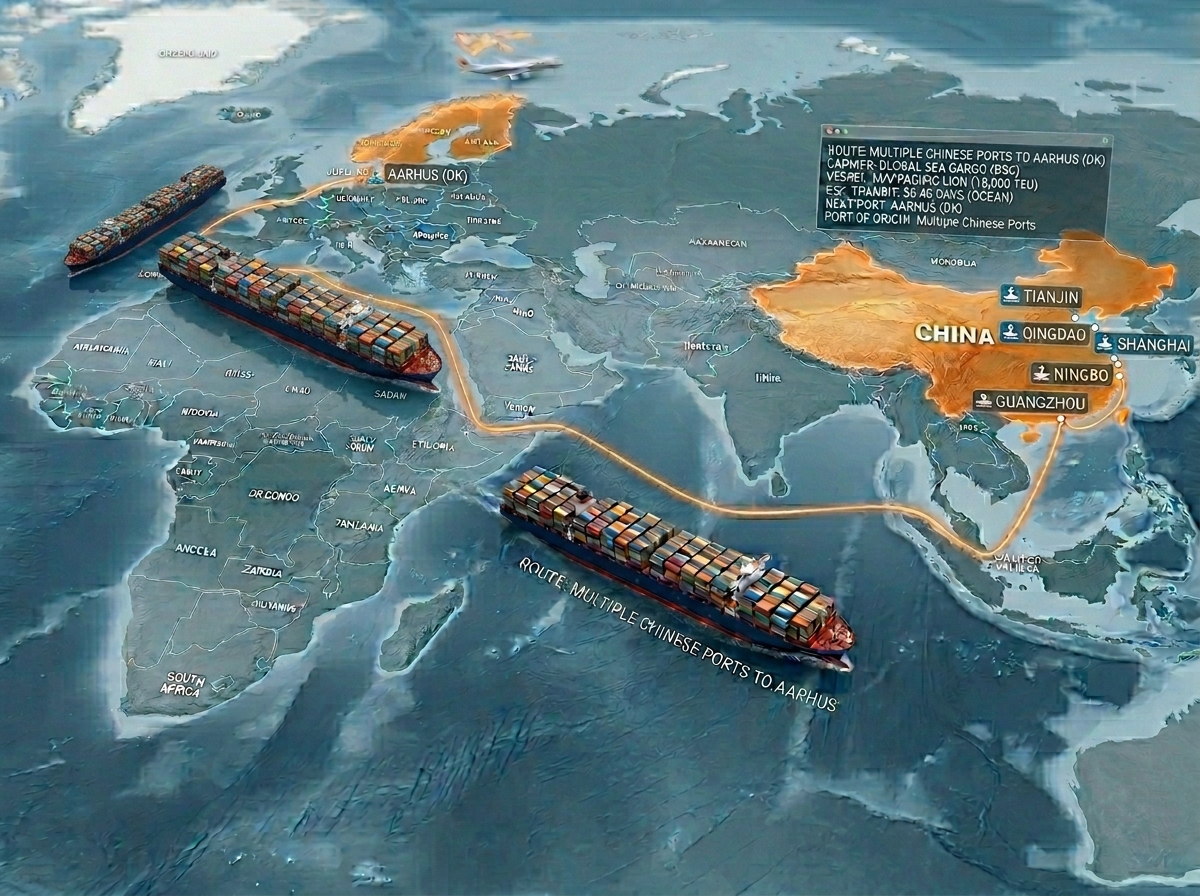
Figure 1: Deep-sea container vessel navigating international shipping lanes from major Chinese ports toward Northern Europe and Denmark.
2. What Are Incoterms 2020/2024 Rules and Why Do They Matter for Denmark Trade?
Incoterms—short for International Commercial Terms—are a set of eleven universally recognized three-letter trade abbreviations created and maintained by the International Chamber of Commerce (ICC) in Paris, France. First established in 1936 and periodically updated every decade (with the latest Incoterms 2020 framework governing contemporary trade practices through 2024 and beyond), these rules serve as the authoritative global language of international logistics.
To avoid dangerous commercial mistakes, every importer in Denmark must understand what Incoterms do—and what they explicitly do NOT do. Incoterms are not a complete contract of sale. They do not define the purchase price of the goods, specify the payment terms (e.g., Letter of Credit, Telegraphic Transfer, CAD), dictate title ownership transfer, or outline remedies for breach of contract. Those legal elements must be defined separately in your commercial sales contract.
Instead, Incoterms govern three core operational pillars of cross-border trade:
- Allocation of Obligations (Who Does What?): Who is contractually required to organize inland trucking in China, book international ocean or air freight, secure marine cargo insurance, submit Chinese export declarations, clear Danish customs at Aarhus port, and execute final delivery to a warehouse in Odense?
- Allocation of Costs (Who Pays for What?): Who settles the bill for origin port handling charges (OTHC), freight surcharges, bunker adjustment factors (BAF), destination terminal handling charges (DTHC), Danish customs duties, and Danish value-added tax (SKAT Moms)?
- Transfer of Risk (Where Does Financial Risk Shift?): At what exact physical location does the risk of physical loss, theft, water damage, or destruction of the goods shift from the Chinese supplier to the Danish buyer?
In the context of China-Denmark trade, understanding the precise point of risk transfer is paramount. Because goods travel across thousands of nautical miles, pass through multiple ocean transshipment hubs (such as Singapore, Colombo, Rotterdam, or Bremerhaven), and cross EU borders, a clear definition of risk prevents catastrophic financial disputes when maritime emergencies, weather delays, or cargo losses occur.
Struggling to Select the Right Incoterm for Your Next Order?
Our international trade specialists will review your supplier contract, cargo specifications, and budget to build a customized, risk-free shipping strategy.
Get a Free Incoterms Consultation3. Exhaustive Operational Breakdown: Top 5 Incoterms Rules Used in China-Denmark Trade
While the ICC defines 11 distinct Incoterms, international trade between Chinese factories and Danish buyers is overwhelmingly dominated by five specific terms. Below is an exhaustive breakdown of each rule, examining operational procedures, cost distributions, risk transfer mechanics, and strategic pros and cons.
3.1 EXW (Ex Works) – Maximum Buyer Risk, Cost, and Administrative Liability
Under the Ex Works (EXW) term, the Chinese seller’s commercial obligation is fulfilled at the lowest possible level. The seller simply makes the packaged goods available at their own factory floor, warehouse, or facility in China (for example, a manufacturing plant in Kunshan, Jiangsu Province). The seller is not even obligated to load the goods onto the collecting vehicle dispatched by the buyer, nor are they responsible for clearing the goods through Chinese export customs.
Operational Workflow on the China-to-Denmark Route:
If a Danish medical equipment distributor headquartered in Aarhus purchases precision components under EXW terms from a manufacturer in Suzhou, the Danish buyer assumes total operational and financial responsibility from the moment the goods leave the factory floor. The Danish company must hire a professional freight forwarder like Supertrans Logistics to handle every step of the logistics chain:
- Dispatching a Chinese domestic container truck to the Suzhou factory.
- Arranging labor or equipment to load the cargo onto the truck.
- Transporting the cargo to the Port of Shanghai or Shanghai Pudong Airport (PVG).
- Appointing a licensed Chinese customs broker to lodge the export declaration under an authorized Chinese export license entity.
- Paying all origin terminal handling charges (OTHC), documentation fees, and security fees.
- Booking and managing ocean freight shipping to the Port of Aarhus or air freight to Copenhagen.
- Executing Danish customs clearance, paying SKAT import duties and 25% import VAT.
- Trucking the goods from Aarhus port to the final facility in Jutland.
Critical Dangers of EXW for Danish Importers:
- Chinese Export Compliance Obstacles: Chinese customs law strictly regulates export declarations. Foreign companies cannot legally submit export customs entries in China directly without a registered Chinese corporate presence. If your Chinese supplier refuses to provide export documentation under EXW, your freight forwarder must utilize third-party export trading agent licenses, adding operational friction and cost.
- Uninsured Factory Loading Accidents: Under strict EXW rules, if the seller’s forklift driver accidentally drops a pallet of high-value goods while loading your truck at the factory, the seller is legally not responsible for the damage because delivery was completed when the goods were made available on the floor.
- Unpredictable Local Origin Fees: Unforeseen delays, warehouse storage fees, or Chinese customs inspection charges at origin fall 100% on the Danish buyer.
Strategic Verdict: EXW should generally be avoided by Danish buyers unless you have a dedicated local office in China or partner with a turnkey freight manager like Supertrans Logistics capable of executing comprehensive origin management.
3.2 FOB (Free On Board) – The Preferred Standard for Maritime Importing
Free On Board (FOB) is one of the oldest and most widely utilized maritime trade terms in global commerce. It is strictly designated for sea and inland waterway transport. Under FOB, the Chinese supplier is contractually obligated to pay for all origin trucking, local factory loading, warehouse storage, and Chinese export customs clearance. Crucially, the seller must physically load the goods on board the ocean vessel nominated by the buyer at the named Chinese port of departure (e.g., FOB Shanghai, FOB Ningbo, FOB Shenzhen).
Risk Transfer Mechanics:
The exact moment of risk transfer under modern FOB rules occurs when the cargo is safely loaded on board the vessel at the Chinese port. Once the container crosses the ship’s rail and is secured on board, the risk of loss or damage transfers instantly from the Chinese supplier to the Danish buyer. From that exact second onward, the buyer assumes responsibility for ocean freight costs, marine cargo insurance, transit damage, Danish arrival charges, customs clearance, and final delivery.
Why Danish Importers Prefer FOB:
- Complete Freight Rate and Route Control: Under FOB, the Danish buyer selects the freight forwarder (Supertrans Logistics) and negotiates ocean freight rates directly. This prevents Chinese suppliers from inflating shipping costs or assigning cargo to low-quality, slow-transit feeder carriers.
- Enhanced Supply Chain Visibility: Because Supertrans Logistics handles the carrier booking on your behalf, you receive direct real-time tracking, transparent bill of lading (B/L) management, and proactive vessel scheduling updates from Shanghai to Aarhus.
- Avoidance of Predatory Destination Charges: By controlling the ocean freight contract, the Danish buyer eliminates the risk of hidden destination fees often concealed in supplier-controlled CIF shipments.
3.3 CIF (Cost, Insurance, and Freight) – Supplier Control with Hidden Buyer Risks
Under Cost, Insurance, and Freight (CIF) terms, the Chinese supplier assumes responsibility for arranging and paying for ocean freight transport to the designated port of destination in Denmark (e.g., CIF Port of Aarhus). Furthermore, the seller is obligated to purchase marine cargo insurance to protect the buyer’s interest during international ocean transit.
The Universal CIF Misconception in Denmark:
A widespread and costly misunderstanding among Danish importers is the belief that under CIF terms, the supplier retains risk until the goods land safely in Denmark. This is completely false. Just like FOB, under CIF terms, the risk of loss or damage transfers to the Danish buyer at the Chinese port of origin as soon as the goods are loaded on board the ship.
If an ocean vessel encounters a severe storm in the Indian Ocean or suffers a container fire, the financial loss belongs to the Danish buyer. The buyer must then attempt to recover their loss by filing a claim against the marine insurance policy purchased by the Chinese supplier from a Chinese insurance underwriter.
Major Operational Pitfalls of CIF for Danish Importers:
- Inadequate Marine Insurance Coverage: By default, CIF rules only mandate the seller to purchase minimum cargo insurance coverage—specifically Institute Cargo Clauses (C). This basic tier covers major catastrophes (such as vessel sinking or grounding) but completely excludes common shipping damages such as rough handling, partial sea-water ingress, theft, or condensation damage.
- The China Import Service Fee (CISF) Trap: Unscrupulous origin agents in China often partner with suppliers to offer artificially low or even "free" ocean shipping under CIF. However, once the container arrives at the Port of Aarhus or Copenhagen, the destination agent demands exorbitant fees—known as China Import Service Fees (CISF) or inflated Terminal Handling Charges (DTHC)—before releasing the bill of lading. The Danish importer is held hostage by these inflated local fees.
- Lack of Vessel Control: The Chinese supplier selects the carrier, often choosing cheap, multi-stop transshipment routes that extend transit times from 35 days to over 55 days.
3.4 DAP (Delivered at Place) – Versatile Door-to-Door Logistics
Delivered at Place (DAP) is a highly modern, flexible Incoterm applicable to all modes of transportation—including sea freight, air freight, rail transport, and multi-modal logistics. Under DAP terms, the Chinese seller (operating through an experienced freight forwarder like Supertrans Logistics) is responsible for delivering the goods all the way to the buyer’s specified destination in Denmark (e.g., a commercial warehouse in Odense or a distribution center in Aalborg), ready for unloading.
Operational Division of Duties under DAP:
The seller handles origin transport in China, export clearance, ocean or air carriage, destination port handling at Aarhus, and inland trucking across Denmark. However, there is one crucial line of demarcation: the Danish buyer remains legally responsible for import customs clearance, paying import tariffs to SKAT, and settling the 25% Danish import VAT.
Why DAP Works Well for Established Danish Companies:
DAP offers an exceptional balance for companies that maintain their own internal customs registration and local tax structures in Denmark. It relieves the Danish business from managing complex global freight routing while keeping local customs compliance under their direct corporate control.
3.5 DDP (Delivered Duty Paid) – The Complete Turnkey "Hands-Off" Solution
Delivered Duty Paid (DDP) represents the absolute maximum level of obligation for the seller and zero operational burden for the buyer. Under DDP terms, the seller assumes 100% of the responsibility, cost, and risk required to deliver the goods to the buyer’s door in Denmark, fully cleared through Danish customs with all duties, tariffs, fees, and import VAT fully paid.
Why Demand for DDP Shipping to Denmark Has Exploded:
- Zero Supply Chain Friction: For Danish buyers, purchasing under DDP is as simple as buying from a local supplier down the street. You place the purchase order, and the goods arrive at your warehouse door without requiring you to manage freight bookings, customs declarations, or port clearance.
- Fixed Landed Cost Security: DDP provides absolute financial certainty. The price quoted by your supplier or freight partner is the exact final price you pay. There are no surprise bills for port demurrage, customs inspection fees, or currency adjustments.
- The Role of Supertrans Logistics in DDP Success: Non-EU sellers in China often face significant legal hurdles attempting to register directly for Danish VAT or submit customs declarations with SKAT. Supertrans Logistics acts as the specialized logistics bridge. Through our established Danish logistics infrastructure and fiscal representation solutions, we seamlessly execute DDP logistics on behalf of Chinese manufacturers and Danish buyers, ensuring total statutory compliance and rapid delivery.
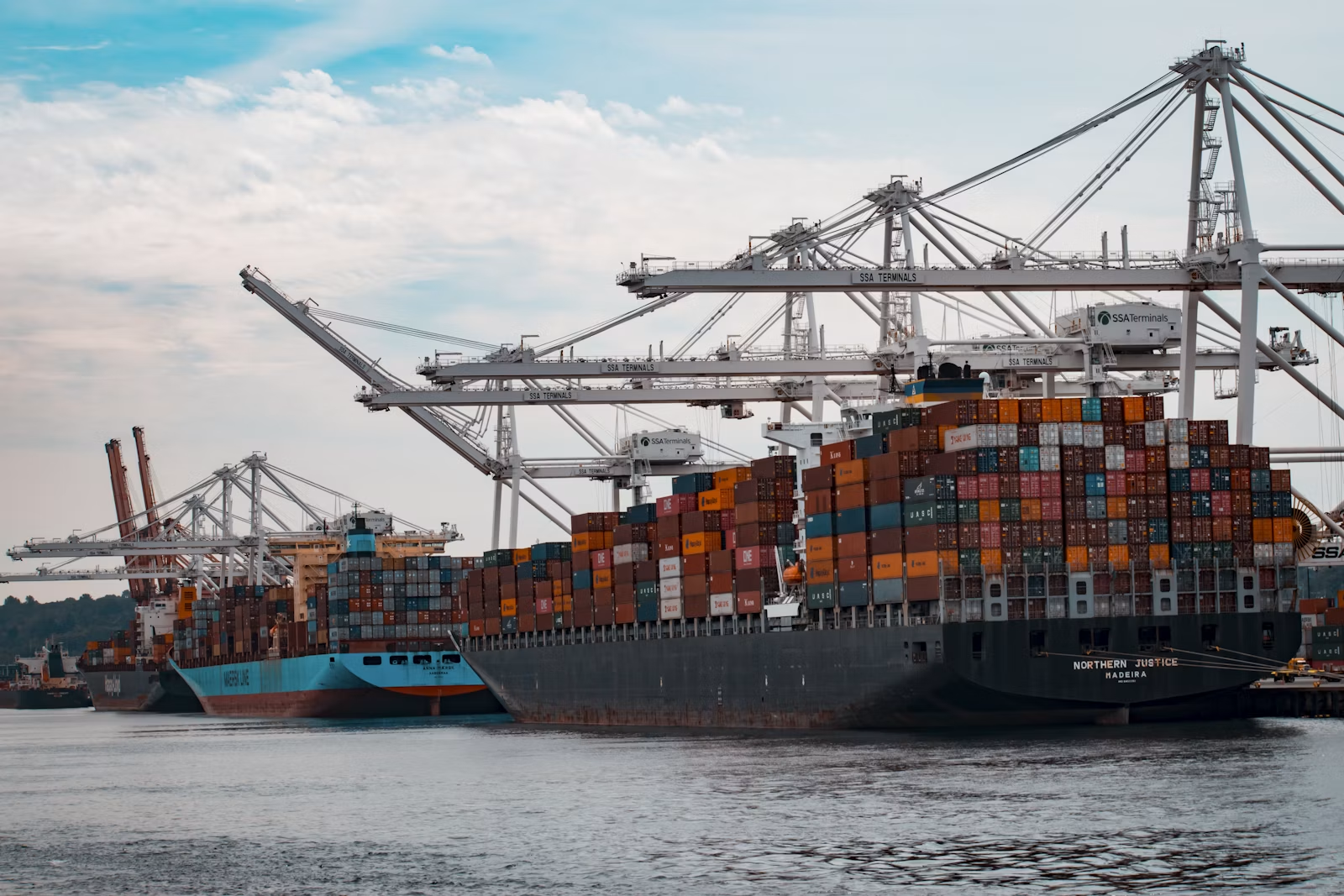
Figure 2: Automated port terminal operations staging containers for ocean freight loading in East China.
4. Side-by-Side Comparison Matrix for Procurement Managers
To assist procurement directors, supply chain analysts, and financial controllers in evaluating trade terms, the matrix below outlines the division of obligations across the top 5 Incoterms rules for China-Denmark shipping corridors:
| Incoterm Rule | Mode of Transport | Exact Point of Risk Transfer | China Export Customs | Ocean / Air Freight | Danish Import Clearance | SKAT Duties & Import VAT | Final Delivery in Denmark |
|---|---|---|---|---|---|---|---|
| EXW | Any Mode | At factory floor in China | Buyer Responsibility | Buyer Pays | Buyer Handles | Buyer Pays | Buyer Arranges |
| FOB | Sea / Inland Waterway | Onboard ocean vessel at China port | Seller Responsibility | Buyer Pays | Buyer Handles | Buyer Pays | Buyer Arranges |
| CIF | Sea / Inland Waterway | Onboard ocean vessel at China port | Seller Responsibility | Seller Pays | Buyer Handles | Buyer Pays | Buyer Arranges |
| DAP | Any Mode (Multimodal) | At buyer facility in Denmark (before unloading) | Seller Responsibility | Seller Pays | Buyer Handles | Buyer Pays | Seller Arranges |
| DDP | Any Mode (Multimodal) | At buyer facility in Denmark (cleared & paid) | Seller Responsibility | Seller Pays | Seller Handles | Seller Pays | Seller Arranges |
Compare Real-Time FOB vs. DDP Freight Shipping Rates Today
Get instant clarity on your total landed costs from Shanghai, Ningbo, or Shenzhen to Aarhus and Copenhagen.
Get Your Custom Freight Quote5. Operational Breakdown: The Shanghai to Aarhus Route Profile & Logistics Dynamics
To choose the right Incoterm, importers must understand the physical and operational realities of the primary transport route connecting China and Denmark: the Shanghai-to-Aarhus maritime transit corridor.
Major Chinese Ports of Departure
China boasts the world's most modern maritime port infrastructure. Depending on where your factory is located, your cargo will typically exit through one of three major port clusters:
- Port of Shanghai (Yangshan Deepwater Port & Waigaoqiao): The world’s largest container port, serving suppliers located across Shanghai Municipality, Jiangsu Province, and Anhui Province. Offers unmatched vessel scheduling frequency and direct carrier calls to Northern Europe.
- Port of Ningbo-Zhoushan (Beilun Port Area): Located in Zhejiang Province, Ningbo is the primary export gateway for industrial machinery, plastics, hardware, and automotive parts manufactured in Southern East China.
- Shenzhen Ports (Yantian, Shekou, Chiwan): The logistics engine of the Pearl River Delta, handling high-value consumer electronics, telecommunications gear, and textiles from Shenzhen, Dongguan, and Guangzhou.
Primary Danish Destination Gateways
- Port of Aarhus: Denmark’s dominant container port, handling over 60% of all containerized imports entering the Kingdom. Featuring water depths capable of accommodating ultra-large container vessels (ULCVs), Aarhus serves as the core logistics hub for distribution throughout Jutland, Funen, and direct feeder links to Scandinavia.
- Port of Copenhagen (Copenhagen Malmö Port - CMP): Located on the Øresund strait, CMP handles specialized containerized goods, roll-on/roll-off (RoRo) cargo, and bulk commodities serving the capital region and Southern Sweden.
- Copenhagen Airport (CPH) & Billund Airport (BLL): For time-critical, high-value, or perishable shipments, air freight routes connecting Shanghai Pudong (PVG), Guangzhou (CAN), or Shenzhen (SZX) to Copenhagen Airport deliver rapid 3-to-5 day door-to-door transit times.
Transit Durations and Shipping Timelines
Standard ocean freight transit times from Shanghai to Aarhus range between 32 and 42 days for direct ocean carrier services. If cargo undergoes transshipment at major European hubs such as Rotterdam or Bremerhaven, transit times can extend to 45+ days. Air freight options managed by Supertrans Logistics compress this delivery window down to 3 to 7 days door-to-door, including customs processing.
Logistics Insight from Supertrans Logistics:
During global supply chain disruptions or peak shipping seasons (such as the pre-Chinese New Year rush in January/February or the peak retail rush in September/October), ocean carriers often implement blank sailings (canceled voyages) or container roll-overs. Partnering with Supertrans Logistics under FOB or DDP terms ensures your cargo receives priority space allocation and flexible re-routing via alternative European hubs.
6. Danish Customs Brokerage, SKAT VAT, and EU Regulatory Compliance
Navigating customs clearance in Denmark requires absolute adherence to European Union customs protocols enforced locally by the Danish Customs Agency (Toldstyrelsen) and Tax Agency (SKAT). Missteps in customs filings can lead to severe fines, cargo seizure, or extended port storage fees.
Essential Compliance Requirements for Importing to Denmark:
- EORI Registration: Every business entity importing commercial goods from China into Denmark must possess an active European Union EORI (Economic Operators Registration and Identification) number linked to their Danish CVR (business registration) number.
- Harmonized System (HS) Code Accuracy: Goods must be correctly classified under the 10-digit EU TARIC code system. The HS code dictates the exact customs tariff rate, which typically ranges from 0% (for many high-tech electronics) to over 12% (for specialized textiles and footwear).
- Danish Import VAT (Moms) Management: Denmark enforces a standard value-added tax rate of 25% calculated on the total CIF landed value of the goods plus the customs duty amount. Registered Danish companies usually utilize reverse charge VAT mechanisms, provided import documentation is correctly lodged with SKAT.
- EU CE Marking & Product Safety Directives: Products sold in Denmark—particularly electronics, toys, machinery, and medical products—must strictly comply with EU product safety laws (CE marking, RoHS, REACH directives). Danish customs officials routinely inspect incoming containers at Aarhus port; non-compliant goods will be detained or ordered destroyed at the importer's expense.
Supertrans Logistics provides complete customs brokerage support, verifying product documentation prior to export in China to guarantee 100% smooth, delay-free customs clearance upon arrival in Denmark.
7. Cost Architecture: Identifying and Eliminating Hidden Freight Charges
A primary objective of professional logistics management is eliminating unexpected financial surprises. When importing under different Incoterms, buyers must account for the total landed cost structure:
1. Origin Charges (China Side)
- Inland container trucking from factory to origin port
- Export customs brokerage and export license fees
- Origin Terminal Handling Charges (OTHC)
- SOLAS Verified Gross Mass (VGM) weighing fees
- Bill of Lading (B/L) documentation and telex release charges
2. Main Transit Charges
- Base Ocean Freight (FCL per container or LCL per CBM) / Air Freight per kg
- Bunker Adjustment Factor (BAF) and Low Sulfur Surcharges
- Peak Season Surcharge (PSS) and Currency Adjustment Factor (CAF)
- Marine Cargo Insurance premium
3. Destination Charges (Denmark Side)
- Destination Terminal Handling Charges (DTHC) at Port of Aarhus
- Port security (ISPS) and environmental levies
- Danish customs brokerage and document release fees
- SKAT Customs Duties and 25% Import VAT
- Demurrage and Detention charges (if container return exceeds free time)
- Inland drayage / final-mile trucking to warehouse in Jutland or Zealand
Working with Supertrans Logistics guarantees total price transparency. We provide comprehensive, itemized landed cost calculations so you know every fee before your shipment leaves China.
8. Real-World Case Studies in Nordics Supply Chain Optimization
Case Study 1: Odense Green Technology Importer Transitioning to DDP
Challenge: A fast-growing green technology firm in Odense was purchasing solar mounting hardware from multiple factories in Zhejiang, China under EXW terms. Managing origin pick-ups, export licenses, and separate shipping invoices consumed massive administrative bandwidth, while unexpected origin trucking fees reduced gross profit margins by 15%.
Solution: Supertrans Logistics implemented a consolidated DDP (Delivered Duty Paid) door-to-door solution. Supertrans collected cargo from all regional suppliers, consolidated goods into single 40ft High Cube containers in Ningbo, managed export/import clearances, paid duties, and delivered containers directly to the client's Odense facility.
Outcome: The client reduced total logistics costs by 19%, eliminated internal administrative overhead, and achieved 100% predictable landed cost calculations.
Case Study 2: Copenhagen Retailer Optimizing Margins via FOB Shanghai
Challenge: A high-end home retail brand in Copenhagen was purchasing consumer products under CIF Copenhagen terms from a supplier in Shanghai. The client suffered from erratic transit schedules (exceeding 50 days) and was repeatedly blindsided by exorbitant "China Import Service Fees" (CISF) charged by the supplier's destination agent before container release.
Solution: Supertrans Logistics advised the client to renegotiate purchasing agreements to FOB Shanghai. Supertrans took control of ocean freight bookings, routed shipments on direct 34-day ocean services directly to Aarhus, and eliminated third-party agent markups.
Outcome: The retailer saved over $1,600 USD per container in destination fees, slashed transit times by 16 days, and gained real-time supply chain tracking.
9. Why Partner with Supertrans Logistics for China-to-Denmark Freight?
At Supertrans Logistics, we are recognized as an elite international freight forwarder specializing in East Asia to Northern Europe shipping corridors. We empower Danish businesses with seamless, reliable, and cost-effective supply chain solutions.
Our Core Value Proposition:
- Dedicated China-Denmark Trade Lane Expertise: We manage daily ocean FCL/LCL, air freight, and express cargo routes connecting major Chinese ports with Aarhus, Copenhagen, Billund, and Odense.
- Transparent Freight Rate Guarantee: No hidden origin fees, zero inflated destination charges, and crystal-clear itemized quotes tailored to your chosen Incoterm.
- Turnkey DDP & DAP Solutions: We take the pain out of cross-border trade by managing origin trucking, export compliance, international transit, Danish customs clearance, tax handling, and final delivery under a single contract.
- Direct Vessel Space Protection: Enjoy guaranteed container space and container equipment availability during peak shipping seasons through our direct service contracts with top ocean lines (Maersk, MSC, COSCO, CMA CGM).
- 24/7 Supply Chain Visibility: Work with dedicated logistics professionals who provide proactive updates, instant tracking, and personalized customer support.
10. Strategic Recommendations & Actionable Importer Checklist
Before finalizing your next commercial purchase contract with a Chinese manufacturer, follow this strategic decision checklist to protect your company's interests:
- Match Incoterm to Operational Capabilities: If you lack dedicated logistics personnel in China, avoid EXW. Choose FOB for maximum freight rate control, or DDP for a hands-off, fixed-cost experience.
- Explicitly Define the Incoterm Version: Always specify the exact ICC standard
in your purchase contracts—e.g.,
FOB Shanghai Port (Incoterms 2020)orDDP Aarhus Warehouse (Incoterms 2020). - Audit Marine Insurance Coverage: If importing under CIF terms, verify that the supplier purchases comprehensive Clause A cargo insurance rather than basic Clause C coverage.
- Verify EORI and Product Compliance: Ensure your Danish business possesses an active EORI number with SKAT and that imported products carry required CE certifications prior to shipment departure.
- Engage Supertrans Logistics Early: Consult with our freight specialists before signing supplier agreements to obtain live freight market rates, transit route recommendations, and custom logistics planning.
